
Tips on Talking with a Child about Purging and Organizing

Alphabet and Number BlocksI write this out about 5 years ago and felt I needed to re-post it since this month’s challenge is for Organizing your playroom and toys.

During Memorial Day weekend, after climbing over lots of toys in the heater room, we realized we needed to replace our heater and a/c units. I went on a mission to purge the children’s unused items. With a son who wants to keep everything for the rare occasion his friends or cousins come over, it was not an easy task.

So, I sat down with him and we discussed making room for new more exciting toys! I first explained to him the difference between “needing” and “wanting” to keep items.

“Wanting” is wishing to keep something because there was a connection to it in the past. For example, wanting to keep a doll because your aunt gave it to you when you were younger, but you have not played with it recently, or it is no longer your favorite.

“Needing” is for items that you use today and will use in the future; like reference guides or a storage bin for loose toys and school supplies.

I decided to describe the difference in very simple terms so my 7-year-old would understand it. From my experience; children look to their feelings first to decide if they are willing to get rid of an item. This process helps them distinguish what they are feeling and what to do with the feelings.
It was time to jump right in and start purging! I was so excited! We pulled out everything from the closet. Then, each item we put our hands on we asked these questions:

  1. Is there little or no dust on the object? I explained to him that if it had a lot of dust that meant he has not use it for a while because dust settles on items that have not been moved.
  2. Does he remember the last time he played with it?
  3. Is it a toy for his age?
  4. Does it still fit him?
  5. Is it in good condition?

If he said, “no” to any of these questions, chances are, we could get rid of it without a major meltdown.

We were able to eliminate 12 bags of toys from games to large figures using this process.

To help him let go of those items that were borderline need and want, I promised him I would give these toys to other younger children who may not be able to buy them for him or herself. So, I emailed to friends and family and anything that wasn’t given away went to Goodwill.

Another way to help your child get rid of unused toys is to ask them if there is a toy they want to replace a particular toy(s). You can promise them that they could have a new toy if they get rid of a target number of old toys. This way, your child will also feel that you understand his/her feelings in letting go of items. This will give him the incentive to purge. Chances are, as they get going, they will get excited and start getting rid of a lot more than the target number you agreed on.

As life changes, the new system and items will need to be looked at and modified again. After all, organizing is a process that consistently needs changing depending on the situations and opportunities you experience in your life.  That is the main reason I never get bored with organizing!  The process always changes.  I can create new ways to organize the same space.

Enjoy the change!

Weekly Organizing Challenge for May 13, 2013: Organize the Bedroom Drawers


Flower2013

Happy Mother’s Day!

The week’s organizing challenge is to go through your chest of drawers or dresser and get rid of at least four(4) pieces of clothing that do not fit, are damaged, or you do not wear anymore.  Be sure to check for holes and stains on the garments to help you decide on what to get rid of.  Make a list of items you need to replace if you need.

Happy Organizing!weeklyorganizingchallenge


May’s Monthly Organizing Challenge: Organize Your Child’s Toys

This month’s organizing challenge is to through all the areas that store your child’s toys.  Have your child do this task with you.  If you have several areas, do one or more areas throughout the week so the process is less stressful.toy

  1. Go through each section of the room.  Do a section of the room at a time to make it less stressful. Has your child played with this toy?  If you don’t know, ask your child if he plays with it recently.  If no, it would go in the donate pile if it in good condition.  If it is broken or in bad condition, it goes in the trash or recycle pile.
  2. After you have gone through the purge process and removed all the unwanted items.  Breakdown the areas in zones. Here are some zones to help you: Craft zone: Kids do allow and adult supervised sub-zones, Game zone, Pretend play zone, Exercise zone, Learning zone, and Outside play toys zone.  And, any other zones you may need.
  3. Then, start sorting into these zones.  Find bins that work for the amount of items you have to store in each zones.  Re-purposing existing bins save you money and time.

Let me know how it goes.  I hope this process helps you clear the clutter in your playroom!

Note: Stop back next week where I will talk about how I spoke with my child about getting rid of his toys.  Please come back and check it out.


monthlyorganizingchallenge2

Weekly Organizing Challenge for May 6, 2013: Organize the Shed

Tulips

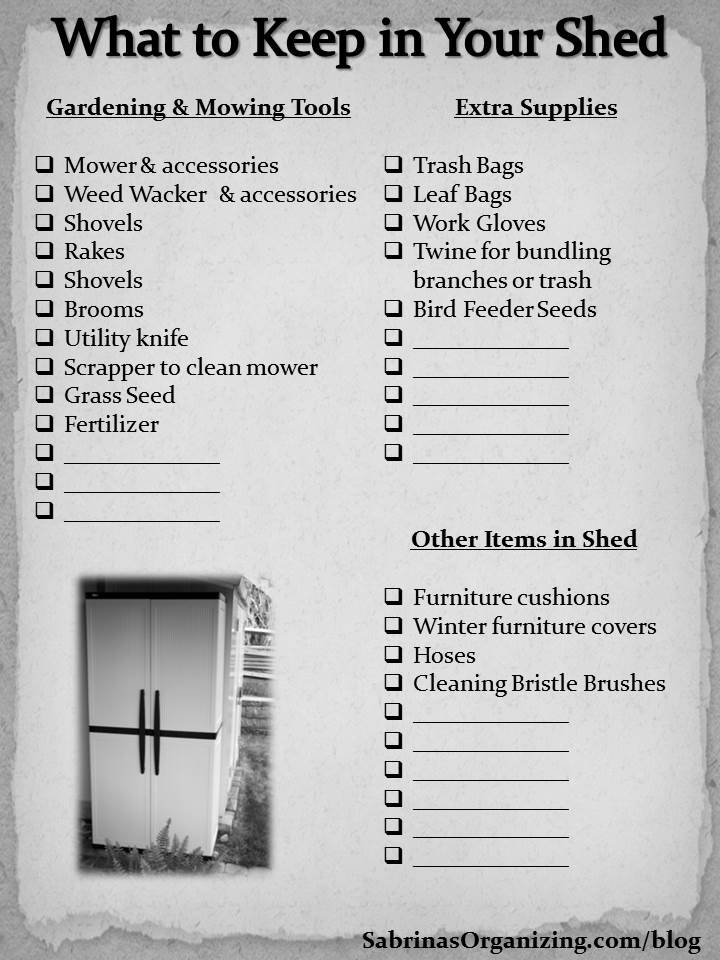
With summer just around the corner, this week’s organizing challenge is to go through your shed and make sure you have all your tools cleaned and in working order. Do you have all the grass seeds you need? How about the treatments you put on your lawn, are they all there? Does your mower need to be serviced?  Make a list of anything you need or have to replace because it is damaged.  Take care of the list this week.

Clearing out the shed and making sure it is well stocked will save you time when doing your weekly chores.

Happy Organizing!


weeklyorganizingchallenge


Create a Customized Wooden Peg Hook

If you saw my recent post about Spring Organizing series, here is the post that describes the process for creating a wooden peg hook, I promised.

First, I started out with this.  You can use as many pegs as you like.  I thought I would use four because it came in a package of two.  The wood was from an IKEA bed support that was no longer being used.  I removed the strap and took out the staples.  I then sanded the wood and drilled holes in the wood for the pegs.

Tools needed

I glued together the $1.00 each words (great deal) to the wood.  Word of advise, get wood glue any other glue may not work.  Put enough to cover the surface but not too much that it would create a mess.  Read the instructions on the glue container.

wooden hookbefore spray paint

Here is the item after the pegs and words are glued on. Doesn’t it look great!

After words and pegs are glued on

To unify the color, I went to town spray painting.  First, I primed with black spray paint and then I did 2 coat spray paint.  Drying between coats.  Here is the final picture.

Final picture after it was dry.

Wooden signs and pegs spray painted black by Sabrina’s Organizing

I then added hooks to the back on the main piece of wood and mounted it on the wall.

After photo used for scarfs, necklaces and light jackets

After photo used for scarfs, necklaces and light jackets by Sabrina’s Organizing

Feel free to share!  I hope you enjoy the transformation!

Happy Organizing and Crafting!

Removing Relationship Barriers through Organizing

No one has ever said, “I am going to buy this item and allow it to come between my loved ones and I.” However, that is exactly what excess clutter does in people’s lives. It takes away from their quality of life.

I have been organizing for many years now and in that time I noticed several similar issues from the clients I worked with.

By the time my clients come to me, they had dealt with the clutter on average 2-5 years. After a while, they did not realize that it was affecting them physically or emotionally. Here were some of the ways that clutter affected them:

  • Angry at themselves, the situation, their family about the clutter
  • Stressed about their cluttered situation and if they can clean it up
  • Physically sick from the amount of pressure they put on themselves to get rid of the clutter.
  • Depressed and helpless that they can’t get out of their cluttered situation.
  • Worried they will not be able to get rid of the clutter.
  • Ashamed and embarrassed that they can’t show anyone else the clutter in their home.

These cluttered spaces became an obstacle in their lives, be it physically or emotionally. Their clutter created a physical and emotional barrier between their relationships with their loved ones.

The motivation to start getting rid of the clutter was always up to the individual who created the clutter.  They had to realize the importance of organizing first and foremost and recognizing that change is not a “bad” thing. Each person needed to get to the point where they drew a line in the sand and said, “No more, I am going to change my habits and my space.  I value myself and my space.” This was the starting point to break down the clutter obstacle that they have created.

When they got to this point, they needed to determine, clearly, what their general goals were for their life. They decided, for the most part, to make their home a place where they could relax and enjoy time with family.

They needed to determine their specific goals for the space. It helped to clear the mind and organize their thoughts first before taking any action.  They needed to be as specific as possible, asking questions like:

  1. What do I want to change in this home or office?
  2. What works? What doesn’t in the space?
  3. What do I want this space to be used for? Family space, other employee space, etc…
  4. Where will I hold the papers? Where will I place my …..?

After they got a clearer picture of what they actually wanted their space to be used for, they needed to write a to do list to reach their goals.

yellow post it note with tack isolated on whiteTry this: Place each task on a sticky note, stick them on a large paper or bulletin board and rearrange the thoughts to put them in most effective order. Be as specific as possible on each task. Then, create realistic “due date” to complete each task. Add these tasks to the weekly calendar to make sure it gets completed.

At this point, clients started doing, purging, and sorting. Start with one task (one sticky note) and complete it. They were focused on one task at a time.

Tip: For tasks that are a chore, allocate enough time to complete it and just do it. Completing this task first helps the process move quickly because you are not thinking about what unpleasant task is coming next.

Remember it took a long time to create this clutter, it will most likely take time to complete it, not as long though. Be strong, stay positive, look at the progress you made, not the incomplete tasks.

After clients completed clearing their cluttered, they felt:

  • happy with themselves and others.
  • proud of what they accomplished.
  • focused on new tasks at hand.
  • stronger in themselves.
  • peace of mind in their home.
  • secure in their space.
  • an overall order and control of their life.
  • they could spend more time with their loved ones.

Are these feelings you want?  Sabrina’s Organizing is here to help make your organizing process easier. I motivate my clients by giving them the ideas as well as the motivation and accountability to complete the goals.

Weekly Organizing Challenge for the Week of April 29, 2013

This week’s organizing challenge is to go through your garage and get rid of anything that needs to be recycled, donated, or trashed.  You know, those items that were left there from the winter months.  We all have them.

Clear out the cabinets and drawers you may have in the garage.  Clean the shelves and drawers.  Vacuum the floor if needed.  Then, sort the items into groups and return to their home.

Happy Organizing!

weeklyorganizingchallenge