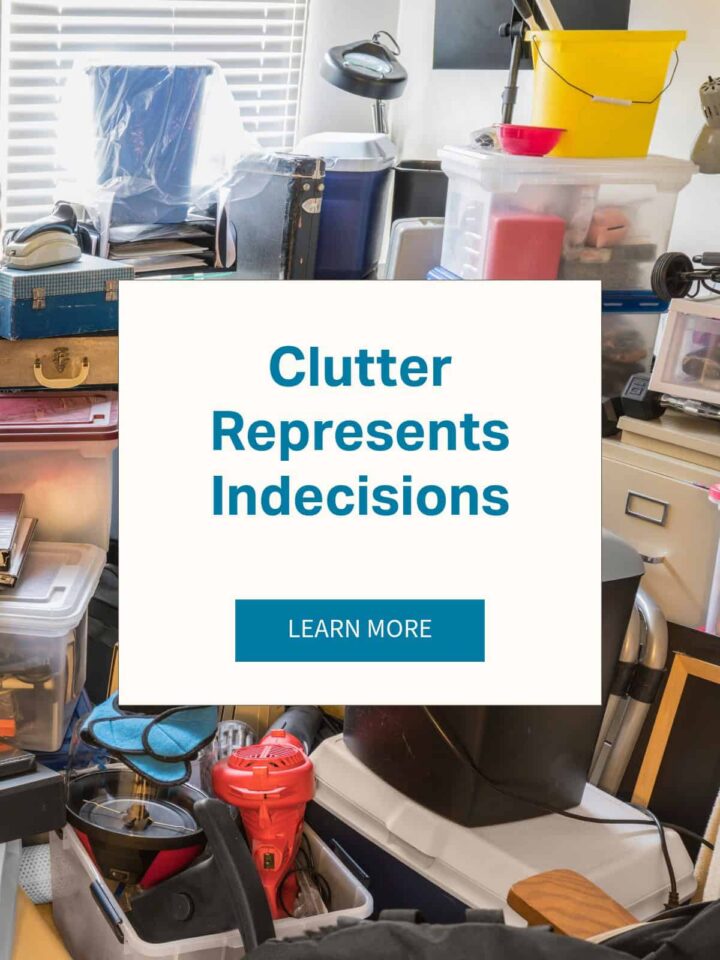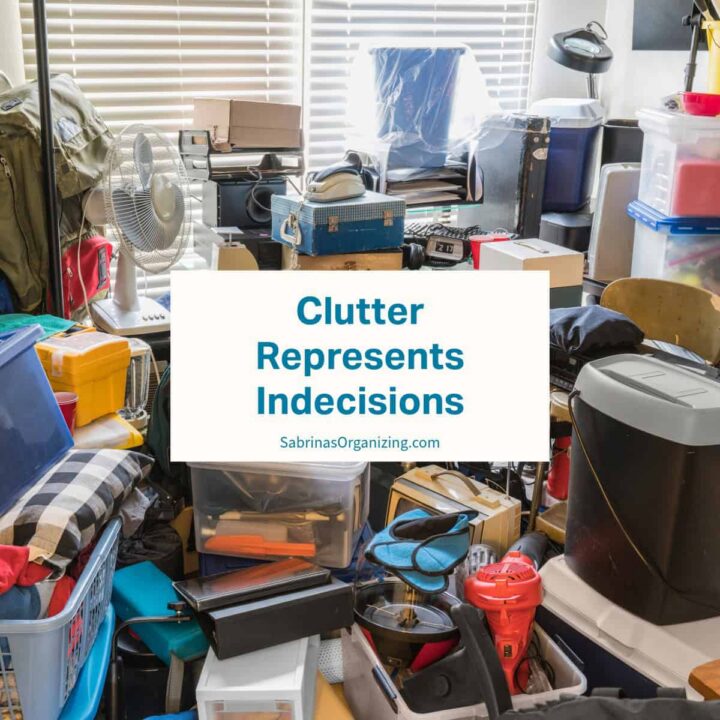
Ever picked up the same sweater five times, put it back on the chair (affiliate), and walked away? Or opened the same junk drawer, stared at a tangle of cords, and closed it again?
That is not laziness. That is indecision.
We leave certain areas of our homes cluttered because, in the moment, making a decision feels harder than walking away. But when we do this in several areas of our lives, we put ourselves in a self-induced predicament. Over time, we can start to feel disconnected, overwhelmed, and even ashamed of our own homes.
The good news? Every cluttered corner is actually a stack of small, unmade decisions - and once you start making them, the clutter begins to clear itself.
Jump to:
- Key Takeaways
- Why Clutter Is Really Just a Pile of Postponed Decisions
- How to Awaken to Clutter Blindness
- Awakening to Clutter in the Home Series
- How to Awaken from Clutter Blindness - Part 1
- How to Take Care of Clutter in the Home {Part 2 of the Awaken to Your Clutter Blindness series}
- How to Sort Kept Items {Part 3 of the Awaken to Your Clutter Blindness Series}
- A Simple 3-Question Decision Framework
- 10 Ways to Jump-start Your Decluttering
- What Is Indecision Clutter Really Costing You?
- My Own Indecision Clutter Story
- Frequently Asked Questions
- Closing
Key Takeaways
- Clutter represents indecisions, stemming from unmade choices in various areas of life.
- Addressing clutter requires making small decisions about each item, such as whether to keep, repair, or discard it.
- Use a simple 3-question framework to assess items: Do I use it? Do I love it? Would I buy it again?
- Tackle decluttering with easy wins, like Old magazines or unused appliances, to clear space and ease mental load.
- Indecision clutter costs you time, mental energy, and peace; making decisions can alleviate these burdens.
Why Clutter Is Really Just a Pile of Postponed Decisions
When I look at a pile of clutter in a client's home, I do not see junk. I see choices that have not yet been made.
Every single item in a cluttered space is waiting for an answer to one of these questions:
- Do I keep this or let it go?
- Where does it actually belong?
- Do I need to repair it, return it, or replace it?
- Am I going to use it - honestly - or am I just hoping I will?
Until you answer one of those questions, the item just sits there. And the longer it sits, the heavier it feels to deal with. That is why a small pile on the counter can start to feel like a giant weight on your shoulders.
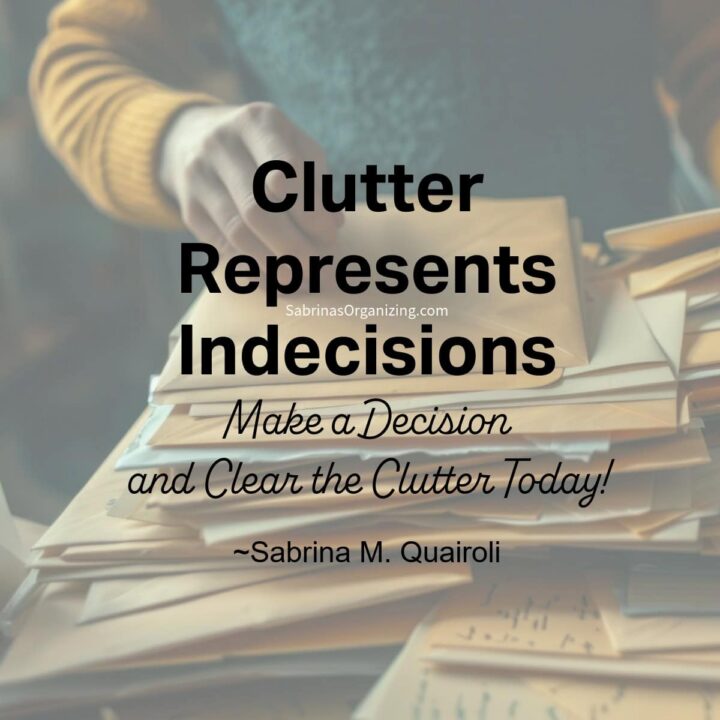
The quote (affiliate) that inspired this post says it best:
"Clutter represents indecisions. Make a decision and clear the clutter today."
- Sabrina Quairoli
How to Awaken to Clutter Blindness
Awakening to the clutter series will give you steps to notice things again in your home. We are creatures of habit and can quickly forget how clutter affects us, so to bring this awareness back, start with part 1.
Awakening to Clutter in the Home Series
How to Awaken from Clutter Blindness - Part 1
Are you wondering where the clutter is in your home? Have you ever walked around your home and couldn't find clutter you didn't want or need?
How to Take Care of Clutter in the Home {Part 2 of the Awaken to Your Clutter Blindness series}
After awakening to clutter blindness, it's time to take action on the lists and tasks you made and eliminate the clutter in the home. Here is the link if you missed it: Awaken to your clutter blindness in Your Home. In this post, we will discuss resources you can use to eliminate the clutter.
How to Sort Kept Items {Part 3 of the Awaken to Your Clutter Blindness Series}
Last time we talked about how to take care of the clutter that you woke up to in the home. In part 3, I will discuss the sorting process to help you when reviewing the items kept. This part of the process will help you see the light at the end of the tunnel.
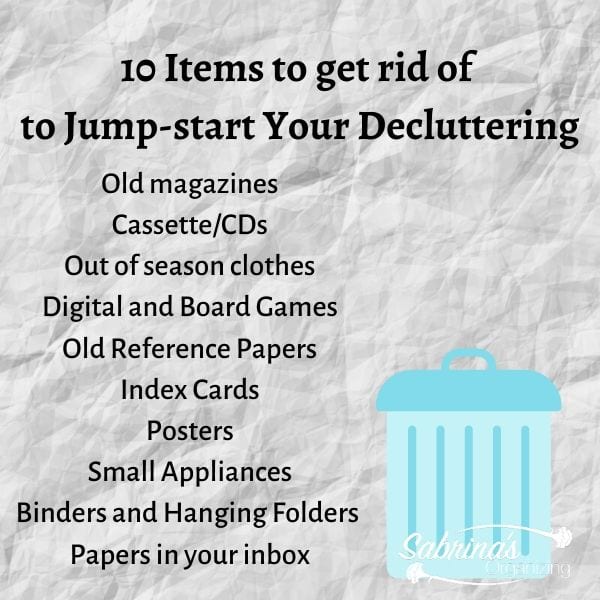
After determining the clutter areas in your home, here are some quick items you can eliminate right now to get emotionally ready for more extensive decluttering projects.
A Simple 3-Question Decision Framework
When you pick up a cluttered item and feel that familiar hesitation, try running it through these three quick questions:
1. Do I use it? Not "might I use it someday" - do I use it in my real, current life?
2. Do I love it? Does it bring me joy, comfort, or genuine usefulness?
3. Would I buy it again today? If I saw (affiliate) it on a store shelf right now, would I pay for it?
If the answer to all three is no, the decision has been made for you. Donate it, recycle it, or toss it, and move on. If you answer yes to any of them, give it a real home in your space - not the floor, not the chair (affiliate), not the counter.
10 Ways to Jump-start Your Decluttering
Here are ten easy wins you can tackle right now. For each one, I have included the hidden indecision behind it and the decision you can make today to move past it.
1. Old magazines. You kept meaning to clip a recipe or re-read an article.
Decision: tear out the one page you want, snap a photo of it, and recycle the rest.
2. Cassette tapes you do not use. You are holding on "just in case" you get another player.
Decision: keep only the sentimental ones, and donate or recycle the rest.
3. Out-of-season clothes that are worn and need replacing. You keep meaning to shop for new ones.
Decision: toss the worn items now and add the replacements to a short list to buy next season.
4. Games you do not play. They feel like they should still be fun.
Decision: if you have not opened the box in a year, donate it to a family who will.
5. Old reference paper in your filing cabinet (affiliate). You are afraid you will need it.
Decision: if it is older than seven years and not tax-related, shred it.
6. Index cards from a past project. You kept them thinking you would reuse them.
Decision: either use them this week or recycle them today.
7. Posters from a project. They remind you of the effort you put in.
Decision: take a photo for your records and recycle the poster.
8. Kitchen small appliances (affiliate) that are never used. You believe you will cook like that "someday."
Decision: If you have not used it in the past year, donate it to someone who will.
9. Binders (affiliate) and hanging folders you have not used in three years. You are keeping the supplies, not the system.
Decision: keep two of each and donate the rest to a school or nonprofit. Check out my Charitable Locations Page for ideas on where to donate.
10. Papers in your inbox. You are waiting until you "have time" to sort them.
Decision: set a 15-minute timer and sort whatever you can into three piles - act, file, or recycle.
What Is Indecision Clutter Really Costing You?
When clutter lingers, it is not just taking up square footage. It is quietly costing you in ways you might not notice day to day:
- Mental load. Every time you walk past a cluttered area, your brain registers it as an unfinished task.
- Lost time. Searching for misplaced items adds up to hours every month.
- Wasted money. You end up re-buying things you already own but cannot find.
- Guilt and shame. Clutter can make you feel like you are failing at something you should have handled a long time ago.
- Missed peace. A cluttered home often means a cluttered mind - and less room to simply relax and enjoy where you live.
Making a decision, even a tiny one, lightens all of those loads at once.
My Own Indecision Clutter Story
I will be honest with you - I am a professional organizer with over 25 years of experience, and I still have my own indecision clutter. For the longest time, I had a small basket by my desk filled with cords, chargers, and little gadgets I could not quite identify. Every time I walked by, I thought, "I should deal with that," and every time, I walked right past it.
One afternoon, I finally set a timer for fifteen minutes and made myself sort the basket. The decision I had been avoiding turned out to take less time than making a cup of tea. Most of the cords were for devices I no longer owned. A few were duplicates. Only three actually belonged to things I still used.
The basket is gone now, and every time I glance at that corner of my desk, I feel a little lighter. That is the power of making one small decision.
I love to remind myself and my clients that the small areas that are never looked at can be the most effective when decluttering. Instead of getting rid of 50% of the stuff in this area, I found we can easily get rid of 80-90% of it. Isn't that amazing! What a way to boost our decluttering journey, right?
Feel free to check out our other decluttering advice for more inspiration. I hope this post helps you get to a simpler life.
Frequently Asked Questions
Most of the time, it is not about the stuff itself - it is about the decisions attached to the stuff. Your brain sees a pile and senses dozens of small choices waiting, which feels exhausting. Breaking the pile into one item at a time makes the decisions manageable.
A mess is temporary and has a home - dishes in the sink, laundry on the bed. Clutter is made up of items that do not have a home, or items you have not decided what to do with yet. Mess gets cleaned up. Clutter needs a decision.
Try the three-question framework above: Do I use it? Do I love it? Would I buy it again today? If you cannot say yes to at least one, it is probably safe to let it go.
In my many years of organizing, I can count on one hand the number of times a client truly regretted letting something go. The relief of the clear space almost always outweighs the occasional "oh, I wish I had kept that." And most items can be replaced if you genuinely need them again.
Start small - one drawer, one shelf, or one 15-minute timer. Decluttering is a decision-making muscle, and like any muscle, it gets stronger with practice. Small, consistent wins beat one exhausting weekend every time.
Check my Charitable Donation Locations in the Philadelphia Area and Recycling and Shredder Events pages for easy options. Getting the items out of your home quickly is key - otherwise the "to-donate" pile becomes its own new clutter.
Closing
Taking these steps will move you closer to a home that feels comfortable, calm, and genuinely yours. Remember, it is not about the size of the steps - it is about consistently taking them until the task is done.
So here is my question for you: what is the one item you keep walking past because you cannot decide what to do with it? Tell me in the comments below, and I will reply with a suggestion to help you make that decision today.
And if you want a fresh set of eyes on your whole home, my Solution Consultations and Virtual Organizing services are here to help you stop deciding alone.
Please share with others and discuss what clutter you have in your life.