
How much memorabilia (keepsakes) do you have in your home? Are they stored in boxes (affiliate) in your closet or displayed in cabinets? I challenge you to get these items reduced by at least half. Do you think that is impossible? Follow along and take these first steps in organizing memorabilia.
Whether the memorabilia is from your childhood, your kids', or your parents, minimizing how much space these items need in your home is a quick way to make room in any area. If you want to take on this challenge, read on.
Jump to:
- Key Takeaways
- When to go through your memorabilia (keepsakes)?
- What is memorabilia (keepsake)?
- What is considered memorabilia or a Keepsake?
- Which keepsake item should I get rid of first?
- How to decide what sentimental items to remove?
- How to Store the Memorabilia You Decide to Keep
- Should You Digitize Your Memorabilia?
- Frequently Asked Questions About Organizing Memorabilia
Key Takeaways
- Organizing memorabilia helps reduce clutter and make room in your home, especially during summer when you have extra time.
- Identify what to keep by questioning the significance of items and considering if they spark positive memories.
- Use storage solutions like labeled bins, designated boxes (affiliate) for family members, or archival albums to keep memorabilia organized.
- Digitizing keepsakes can preserve memories without taking up physical (affiliate) space and allows easy sharing with family.
- Gently let go of items by asking friends for support or donating to someone who may appreciate them.
When to go through your memorabilia (keepsakes)?
The summertime is a great time to go through your memorabilia. "Why," you may ask? First, you have extra time in the evenings to do some extra daylight purging in your home. It's good to do this before you go on another trip. Usually, people travel in the summer months and will most likely buy souvenirs and bring home items to add to the keepsake piles.
What is memorabilia (keepsake)?
We use memorabilia and keepsakes interchangeably. Both mean pretty much the same thing, so throughout this post, we will be talking about memorabilia as keepsakes.
The definition of keepsake is "something kept or given to be kept as a memento." While mementos can be in a variety of sizes, these sentimental items can quickly get out of hand if not kept in check.

What is considered memorabilia or a Keepsake?
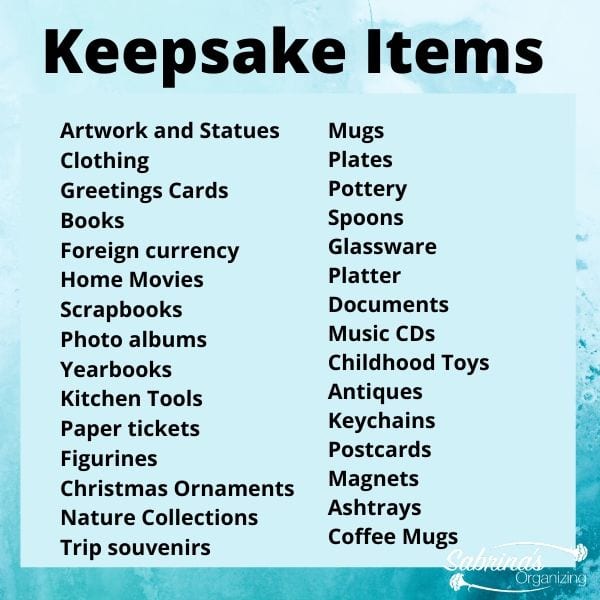
To help you identify your keepsakes, below is a list of examples.
- Artwork and Statues
- Clothing - like concert t-shirts, team, baby clothes, and band t-shirts
- Greeting Cards (affiliate) from other family members.
- Books from trips and favorite stories
- Foreign currency you brought home from a trip abroad
- Home movies recorded on VHS and DVD
- Scrapbooks, photo albums, yearbooks
- Kitchen tools (affiliate): trivets and hot plates from trips you were on or unique gifts from others who traveled
- Paper tickets from events like concerts, theater trips, sports events
- Figurines
- Christmas Ornaments (affiliate)
- Mugs, plates, pottery, spoons, and glassware
- Documents - diplomas, degrees
- Music CDs - it could also be albums
- Childhood Toys - My Little Ponies, Barbies, etc...
- Antiques inherited from others
- Keychains from various events or used during a particular time in your life.
- Postcards - used and unused ones
- Magnets - for the fridge or to use on the car
- Ashtrays - made items from others, collected items from trips
- Coffee (affiliate) Mugs from various times in your life, from trips, or given to you
- Trip souvenirs
- Nature collections - rocks, shells, etc...
Do you relate to any of these sentimental items? If so, leave a comment below to share with visitors.
Make a list of all the keepsake things on a piece of paper. Write down where they are located in the home. This list will be the starting point for your plan of attack.
Which keepsake item should I get rid of first?
This is really up to you. If you need help deciding which item to go through first, ask a close friend or family member to be your sounding board about which one to pick. Select someone who cares about you more than the stuff you own.
After you decide what your memorabilia items are, get your calendar and mark time slots in the coming month or so to review them. Depending on how large (affiliate) the collections are, it may take 15 minutes to a few hours to go through them and remove the ones you can do without. Tell yourself you will be fine and remind yourself that it is OK to get rid of some of your memorabilia.
How to decide what sentimental items to remove?
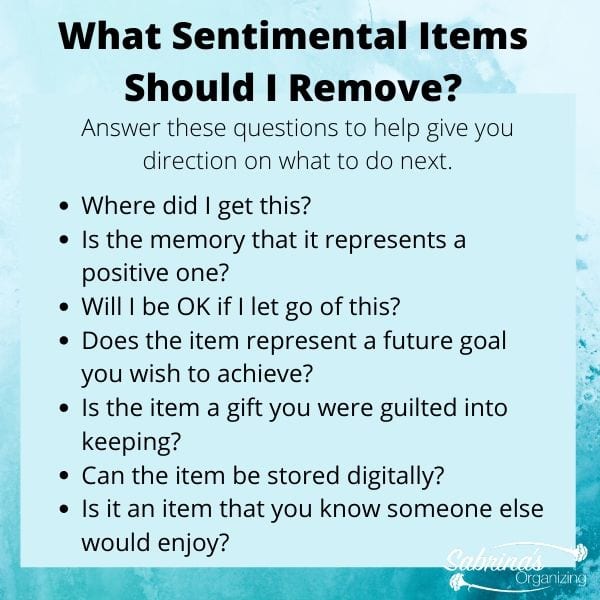
Start with these questions. These questions are geared to give you direction on and ultimately a solution for what to do with those keepsakes.
- Where did I get this? If you can't remember where you bought the item, get rid of it.
- Is the memory that it represents a positive one? If no, get rid of it.
- Will I be OK if I let go of this? If your answer is yes, let it go.
- Does the item represent a future goal you wish to achieve? If no, get rid of it.
- Is the item a gift (affiliate) you were guilted into keeping? If it was, and you do not want it, get rid of it.
- Can the item be stored digitally? If possible, make plans to have the video or photos converted to digital.
- Is it an item that you know someone else would enjoy? Give it to them instead of keeping it around.
Hopefully, by answering these questions, you received some direction on what to do with these items. By reducing the excess of your memorabilia, you will value the items you keep much more deeply.
How to Store the Memorabilia You Decide to Keep
Once you've pared down your collection, giving what remains a dedicated, organized home makes it so much easier to enjoy - and prevents the pile from quietly growing again.
Here are some practical storage ideas to consider:
Use labeled, lidded boxes (affiliate). Clear or labeled storage bins (affiliate) keep memorabilia protected from dust while still letting you find things quickly. Label (affiliate) each box by person or category - "Sabrina's Childhood," "Family Travel," "Kids' School Art."
Create one box per person. One of the simplest rules I love: give each family member their own designated memory box. When the box is full, that's the signal to edit before adding more. This naturally keeps collections from taking over.
Designate a single shelf or cabinet. If you love displaying keepsakes, choose one intentional space - a shelf, a shadow box, or a small display cabinet - and let that be the boundary. When the space is full, something has to come out before something new goes in.
Store flat items in archival binders (affiliate) or albums. For paper keepsakes like cards, programs, and postcards, photo albums (affiliate) or binders (affiliate) with sheet protectors (affiliate) protect them while keeping them organized and easy to flip through.
Keep fragile items wrapped. For figurines, ornaments (affiliate), or pottery, use acid-free tissue paper (affiliate) or small boxes (affiliate) with padding to prevent breakage during storage.
The goal isn't to lock your memories away - it's to give them a home where you can actually find and enjoy them.
Should You Digitize Your Memorabilia?
If you're holding on to physical (affiliate) items primarily because of what they represent, not the objects themselves, digitizing can be a game-changer. This is especially true for photos, home movies, and paper keepsakes.
What can be digitized:
- Printed photos and photo albums
- VHS tapes, DVDs, and 8mm film
- Newspaper clippings, report cards, diplomas, and certificates
- Children's artwork and school papers
- Greeting cards (affiliate) and letters
Options for digitizing:
- Do it yourself with a flatbed scanner (affiliate) or a smartphone scanning app. Apps like Google PhotoScan work well for photos and documents.
- Use a mail-in service like Legacybox or ScanMyPhotos, which will digitize your photos, slides, or tapes and return the originals with a digital copy.
- Check your local library or community center - some offer free or low-cost scanning resources for community members.
Once digitized, store files in cloud services like Google Drive, iCloud, or an external hard drive and consider sharing a folder with family members so everyone can enjoy the memories. This is exactly what I did when clearing out my parents' home: I uploaded everything to a shared website so the whole family could access it.
Physical (affiliate) items that have been digitized are much easier to let go of or to pass along to a family member who would appreciate having the original.
Now that you have cleared half of the memorabilia/keepsake items. It's time to honor the things you have left. Visit our post 8 ideas to Honor Your Memorabilia.
What do you collect? Do you keep them out in the open, in a box in your closet, or somewhere else? What struggles do you have when trying to get rid of memorabilia? Join the conversation and leave a comment below.
Below are some additional posts I found online to help you get rid of sentimental items.
How to Get Rid of Sentimental Clutter and Keep the Memories
Want to take on other challenges? Visit our huge collection of challenges to get you motivated to organize.
Frequently Asked Questions About Organizing Memorabilia
Start small. Pick just one category, like greeting cards or trip souvenirs, and spend 15 minutes going through it. You don't have to tackle everything at once. Blocking small time slots on your calendar makes the process feel manageable rather than overwhelming.
A good rule of thumb is the one-box-per-person rule: if a person's keepsakes overflow one designated box or shelf, it's time to edit.
Not at all. Letting go of a physical object does not mean letting go of the memory. The memory lives with you, not the item. Giving an item to someone who will use and love it is actually a wonderful way to honor it.
Consider gifting it to someone who has a connection to it - a sibling, a cousin, or a family friend. You can also donate items with historical or cultural significance to local museums, historical societies, or libraries. For children's artwork or schoolwork, photographing it before letting it go is a great compromise.
Use labeled, lidded storage bins in a cool, dry location away from humidity and direct sunlight. For paper items, use acid-free albums or archival sleeves. Fragile items like figurines and ornaments should be wrapped individually in tissue paper or padding to prevent damage.
Yes! Depending on the item, you can donate to thrift stores, local historical societies, libraries, schools, or community organizations. Vintage or antique items may also be welcomed by local collectors or resale shops. Always call ahead to confirm what a specific organization accepts.
Absolutely. Digitizing preserves the memory forever without requiring physical storage space. Once photos or videos are digital, you can share them easily with family members and back them up in multiple places. It also frees you to let go of the physical copies without losing what matters most.
Looking for more challenges? Check them out below for more motivation to make your home well organized.



Janet Schiesl says
I'm not a very sentimental person so I don't have much memorabilia. I have one box that my mom collected and I have one box for each of my kids. Of course I have things around my house that I have collected, but most of it I could let go of as well. I do understand why it's hard for some people to manage their collection of memories.
Linda Samuels says
Several years ago, I had to clear out my parents' home they lived in for almost 60 years. You can imagine how much memorabilia I found and had to decide about. It was A LOT. And it was clear we couldn't keep everything. One of the criteria I used was its condition. If it was damaged and not repairable, it went. That helped me weed out the first round. Since I have children, siblings, nieces, and a nephew, I also knew that others might want some of the things. So that was another way of "sharing" or editing. But I also made my parameters about how much (or few) things I wanted to bring into our home. We don't have a lot of space. Plus, not everything meaningful to my parents was significant to me. I carefully chose so that I didn't overwhelm our home with stuff. The hardest part was sorting through the photos and media. I ended up getting everything transferred digitally and then uploading it onto a website for the entire family to be able to access. I let go of most of the source material.
Sabrina Quairoli says
Thank you for sharing, Linda! I created a scrapbook for my children about their grandfather (my dad). Then when my mom passed, I made a cookbook of recipes from my mom with photos included. Now I am going through my childhood albums and pulling pictures that were not of me and giving them to my brother to have after I scan them. He appreciated it. I created a folder on Google Drive to share with him so he can get the digital copies as well. He and my sister-in-law really enjoyed it.
Sarah Soboleski says
I, too, tend to pick up Christmas ornaments on my travels. It's such a fun walk down memory lane each December. I also have a collection of milk glass which is useful for serving and entertaining.
Jill Robson says
Collections can get such a hold on people, these are some great tips to help them go through them.
Janet Barclay says
The only types of souvenirs I'm apt to buy these days are (a) a lapel pin, for my husband's collection; (b) a postcard, for my collection (started when I was a child); ( c) something I'll be able to use, e.g. pottery for the kitchen; (d) a gift for someone else - but it would have to be giftworthy, not just something to show I was there and thought of them. I'm becoming a lot more selective in my old age!
Seana Turner says
My father collects corkscrews. It has been a very fun collection especially because they are small and can be hung for display on the wall. Collections of large items, that need to stashed in the attic, are harder to enjoy.
Sabrina says
Very true - Large collections are so hard to manage. The corkscrew collection sounds interesting. Thanks for leaving a comment.
Kathy says
What a fantastic idea about the ornaments. I started doing that as well and it so nice at Christmas to remember where we were when we bought it. I call that a useful memory! Thanks for the great advice.
Sabrina says
I love it - "Useful memory". Thanks for stopping by.