
Do you wish you had donated more items last year? Do you want to track the items more efficiently? If your goal this year is to give things away and want to make space in your home, this post is for you. These days, not everyone gets a deduction for their charitable contribution, but it doesn't matter if you are like many people. Not everything needs to be donated to a charity or a second-hand store.
Some items can be donated to a fundraiser, a family member, or a friend. But we all store donation items in one or more areas of the home before giving them away. Some people store them in a basement, others in a garage (affiliate); wherever they are, we need to keep them organized so we know what to do with them. This post will help you organize donation items in your home before donating them.
Key Takeaways
- To organize donation items, use bags for easy transport and label (affiliate) them clearly with the recipient's name.
- Designate a specific storage spot in your home for donation items to prevent clutter and make it easier to donate promptly.
- When donating to a charity, list each item with details and keep receipts for tax purposes.
- Use a Donation Tracking Sheet to simplify the organization process and track the value of your donations.
- Set a deadline to donate items and schedule it on your calendar to ensure timely action.
Jump to:
How to manage your donatable items BEFORE giving them away
Whether you are donating to a charity or giving items to family and friends, gather them up and follow these tips to organize your donation.
Place donation items in bags for easy carrying and stacking.
Some people may have issues carrying certain items; using paper or plastic bags with handles works nicely for them; others prefer trash bags (affiliate) with pull tabs (affiliate). If the items do not fit, try a reusable bin. After dropping the items off, take the bin back to refill if needed.
Label the bags.
Each bag should be labeled with the receiver's name. It could say, "Give to Goodwill," "Give to Aunt," or "Give to <<name>>." Labels (affiliate) help remind us what to do in case we forget. You can use a paper sign with the "give to" name and tape it on the bag. Or, write it directly on masking tape or Duct Tape (affiliate) strip adhered to the bag itself. You can even use a Jumbo Sharpie Marker (affiliate) and write it on the bag itself. Make it visible, so you know exactly where it is going.
Find a place in your home for the donation items bags.
We can't always rush out and donate the items right away. So finding a place in your home to store the items is essential. Make the location a spot where only these items go. Nothing else should have a home in that spot. A garage (affiliate) or in-car trunk (affiliate) works nicely. Near a door works well too. It forces you to get rid of it quickly. If the items are delicate, you may want to place them in a temperature-controlled area, such as a hallway or closet.
Are you donating these items to a charity?
Below are tips to remember when organizing items to donate to a charity.
Be sure to list everything you are donating to a charity.
Describe your donated item in detail. Include information like the manufacturer's name, size, type, and color of the items.
If you are tracking them for your tax return deduction, do this task before bringing the items to a charity.
Find the fair market value of each item donated and write it down next to each item on your list. Click here for more information about determining the Fair Market Value from the IRS.
Keep the receipt with the list of donated items.
If you receive a receipt from the charity, be sure to staple it to the completed donation items list.
Place the charity paperwork with your current year's taxes.
Then file and keep the receipt and list of donation items in a tax folder for the end of the year.
Donation Tracking Sheet Printable
Here is a Donation Tracking Sheet to keep donation items organized.
It is a straightforward format, and my clients found it easy to complete. It also helped determine the donation's value to the particular charity. Feel free to check out our "Charitable Locations to Donate Your Stuff" Page, which lists a variety of places across the U.S. based on the item(s) you want to donate.
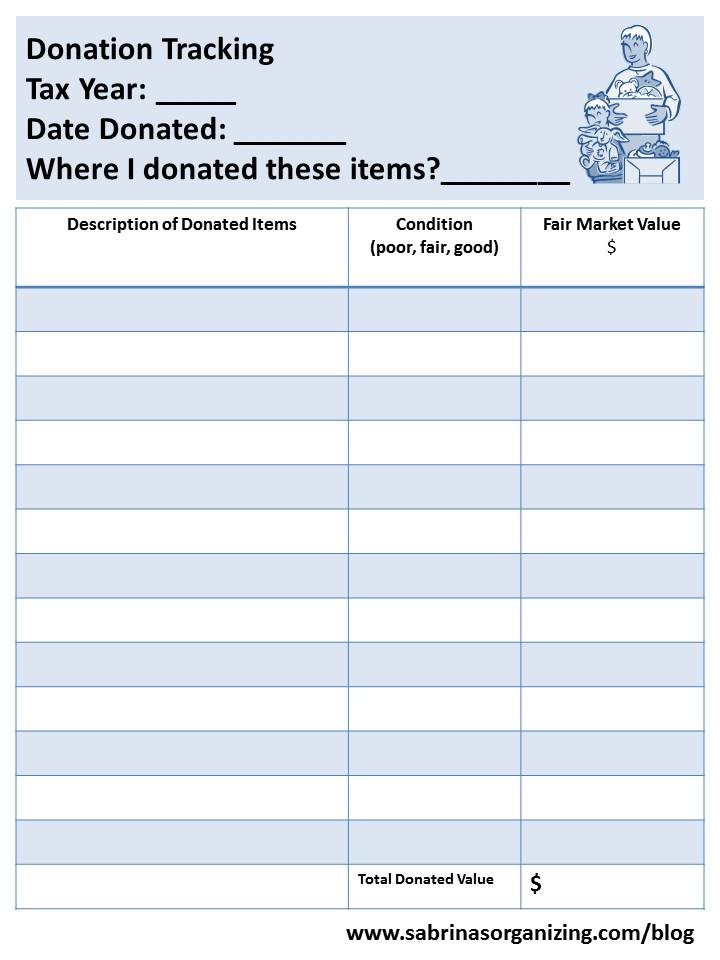
You can create a sheet to use when you need to donate something or print this out for each donation trip.
Take action and get it out of the house!
Now that you found a place for them in your home, don't let them stay there for long. Give yourself a deadline. Mark the donating item action on your calendar and set a notification for that appointment. Schedule the visit within one week. Doing this should give you enough time to fit it into your schedule. The longer you keep it in the house, the more likely you are to forget about it and start decaying.
That's it! By doing these steps, you will be well on your way to tracking and organizing donation items. Do you have a place where you store your donation items? Please leave a comment below. I would love to hear from you. I hope this helps you to organize donation items better and helps you get them out of your home more quickly. Hopefully, they will still be in good condition so that the next person can enjoy them.
Please note these are affiliate links through Amazon (affiliate), and at no additional cost, I will earn affiliate fees if you decide to make a purchase.






Kim says
It is so important to have an "Exit Strategy" for your stuff meaning that when you notice something not needed or wanted any longer there is a place to put it until it gets taken out the door.
One of the participants in the Clearing Clutter group had a great saying which was "Whats in the Box stays in the Box". The longer something stays in the house the more likely the temptation is to look in the box and second guess yourself.
Sabrina Quairoli says
I love the phrase "Exit Strategy"! I totally agree! It's great that you have people in your Clearing Clutter group that are perceptive. =) Thanks for stopping by and commenting.
Seana Turner says
Designating a place for the donations to live until they are taken away is so important. I use an extra cubby in my mudroom, but I think the garage can also be a great place. Having a designated home for donations is one way to keep the concept of donating top of mind - a way to remember that is something we regularly do as we go about the course of daily living. Love this post!
Sabrina Quairoli says
Thanks, Seana, for stopping by and commenting.
Janet Barclay says
I keep clothing I no longer want or need in a box in my closet and household items in a box in my spare room. Once the container is full, I will donate it. Sometimes I will combine the items in one box if a pickup is scheduled, just so I can get the stuff out of my place quickly and easily.
Sabrina Quairoli says
Those are clever ideas for storing these items. Thanks for stopping by and commenting.
Janet Schiesl says
I love the chart. I try to make donating more simple by suggesting that clients estimate what's in a bag of donations. Meaning, I count the pieces of clothing in one bad and estimate that all the other bags of clothing have the same amount of items. I know this is not very thorough but it's easier. You can get overwhelmed with just the idea of counting and estimating the value of each item and stop in the process.
Sabrina Quairoli says
Very true, Janet. I do find it is hard to do with you are purging. I found it was easier to purge, Then, when the client was ready to bag the items, that was when we wrote down the information.
Linda Samuels says
When working with clients, editing is part of the process. And many of those "edits" become donations or giveaways. When we start on a particular day, we discuss this at the beginning of the session and prepare. It's helpful to have the labeled bins or bags ready at the start. Like you, I always stress the importance of getting the outtakes, out! Sometimes that involves scheduling a pick-up or might mean setting aside time on the calendar to drop things off. The idea is once a decision is made to let go, continue with that choice and actually have it move out of your home or office. This action an essential step is the editing process.
Sabrina Quairoli says
I agree, Linda. If they do not do this part of the process, the task of purging will not be complete. Only with completing this action will we feel truly satisfied with getting rid of the items.