
We all worry about the next step in various areas of our lives. Getting ready to declutter is no exception. Today, we are discussing a situation I had with a potential client and how her worrying and family negativity are stopping her from taking action. Read on to discover the questions to ask yourself to overcome your worries about decluttering and where to start.
Jump to:
- Background
- My personal story
- Emotional feelings are essential - examine them.
- Start small when organizing for the first time.
- Block out 4 hours on Sunday to organize a Small Area of the Home.
- Pick areas that others can see
- What is Clutter Shame and How to Deal with It
- Common Fears
- Takeaway from this conversation
- Questions to Ask Yourself If You Are Worrying About Decluttering
- Sabrina's Organizing Virtual Organizing Consultations
Background
I spoke with a woman looking to clear her small home of clutter. She kept telling me that she was just too busy. And then said that she would have to maintain it. Well, of course, I thought. It seems ineffective to spend time and money having a professional organizer set up goals for every room in the house, only to have you not maintain them.
She continued to say that her aunt and brother wouldn't help her because they thought she was too disorganized and would never keep things tidy.
Pro Tip: If you know someone who is chronically disorganized, please refrain from saying this to them. There are many places to get help and support, such as the Institute for Challenging Disorganization and other communities that can help people with their disorganization.
By saying to them, they will never keep it organized; you will stop them in their tracks, and they will never forget that statement when they want to make a change.
“Do not allow negative people to turn you into one of them.” – Anonymous. Read more: Questions To Ask Yourself to Stop Worrying about Decluttering. Share on XAfter expressing her situation, I asked, "Let's put aside what your family is telling you. Do you want to get your home organized and feel more in control of your life?" She said, "Yes." "Well, then let's stop listening to the doubters and start from the beginning," I said. "And let's get started." Follow along and do these various tasks to help curb your worrying.
My personal story
I personally found it more beneficial to focus on the positives of what I have completed, rather than dwelling on the negatives of what I did not accomplish. I would say to myself, "Slow and steady wins the race." Being committed to clearing the clutter and reorganizing a space helps me get through it, no matter how long it takes.
Let's take a moment to start with some of these powerful tools (affiliate) to help you get into the proper frame of mind, so you can focus on decluttering instead of worrying about it.
Emotional feelings are essential - examine them.
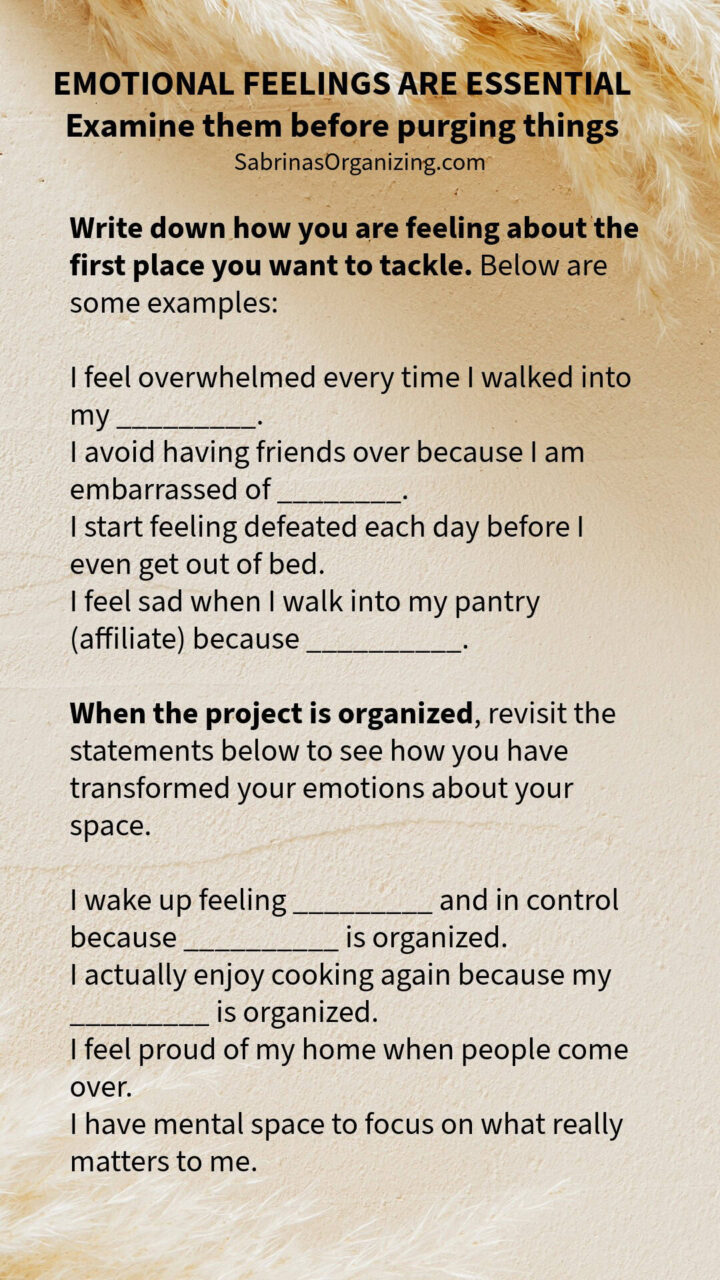
First, write down how you are feeling about the first place you want to tackle. Below are some examples:
- I feel overwhelmed every time I walked into my _________.
- I avoid having friends over because I am embarrassed of ________.
- I start feeling defeated each day before I even get out of bed.
- I feel sad when I walk into my pantry (affiliate) because __________.
Then, when the project is organized, revisit the statements below to see how you have transformed your emotions about your space.
- I wake up feeling _________ and in control because __________ is organized.
- I actually enjoy cooking again because my _________ is organized.
- I feel proud of my home when people come over.
- I have mental space to focus on what really matters to me.
Start small when organizing for the first time.
I told her she needed to start small and stop worrying about completing the entire project. Adding a recurring appointment (with an alarm) to her digital calendar (affiliate) each week helps her begin decluttering and reminds her that she needs to do these tasks. I like Sunday afternoons (between 3:00 PM and 5:00 PM) because people usually do everything they need to do on Saturday, and they have a few hours before preparing dinner and getting ready for the next day.
All it takes is 15 minutes each day
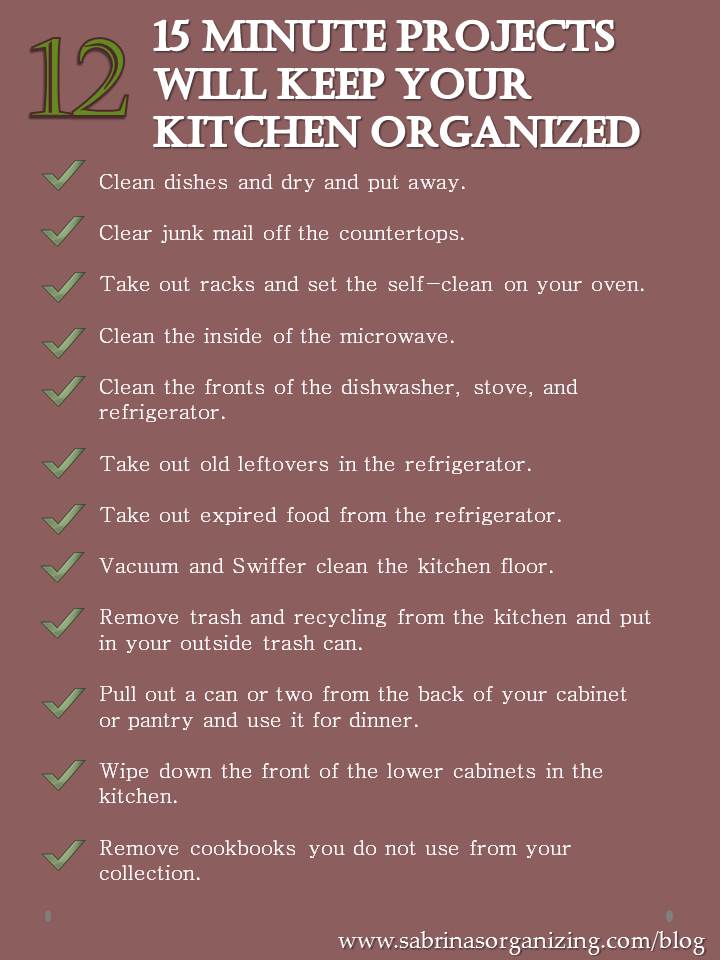
Try my 15-minute organizing challenges listed below to get you motivated and feeling accomplished. These challenges only take 15 minutes, once a day, and will help you feel better about yourself. Just imagine what you can accomplish in a week or even a month.

Block out 4 hours on Sunday to organize a Small Area of the Home.
Another way to stop worrying about decluttering is to set aside a specific time each week. When the day comes to take action, I told her to allocate a few hours at first to clearing out the clutter in the home's central areas, such as the living room or kitchen. Each week, add a few more hours until you reach approximately a 4-hour time slot. In four hours, you can dismantle an area like a small kitchen, bathroom, or closet and completely reorganize it.
Pick areas that others can see
When picking an area of the home, start with the main areas that others will see because:
1. You will be able to see the results and how you feel about the uncluttered space, which will reinforce positive behavior.
2. You will show your family that you can clear the clutter and keep it that way.
I explained to her that clutter doesn't happen overnight. So, it will take time to declutter. This phrase is what I tell myself and my clients when they feel overwhelmed looking at their mess.
What is Clutter Shame and How to Deal with It
I first watched this video in 2015 and recently rewatched it: Brené Brown's "Listening to Shame" video. It is one of my favorite TED Talks. Brené talks about shame and how we say to ourselves, "We Are NEVER Good Enough or Who Do We Think We Are."
After we finished the conversation, she was calmer and more motivated to take action in her space. She no longer needed to listen to her family and be a defeatist. She also realized that the time constraint, not her being messy, was the real issue.
Common Fears
Many people have worries about getting rid of things in their home, regardless of their age or who gave them the item. Let's go through some common fears associated with decluttering and what I would say to my clients and myself when these worries arise.
What if I regret getting rid of something?
Consider the item you want to get rid of. Hold it in your hand and ask yourself,
- Can I afford to repurchase it?
- Will it be something I can find online or in a store?
- Is it something that someone else could use?
- Will the person who gave me this item not be judgmental because I've decided to get rid of it?
- Do I not want the job of taking care of this item?
If you say 'Yes' to all of these questions, I would tell my clients it is okay to get rid of them. These questions help motivate them to take action, which I've observed over 20+ years of organizing homes and offices with clients.
Takeaway from this conversation
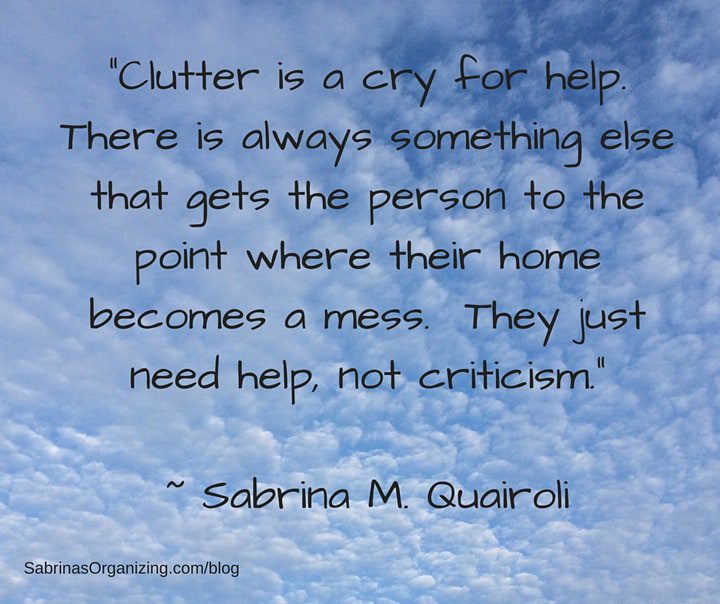
We are hesitant to clear clutter in some regions of our homes. We don't necessarily want the chaos, but we also don't know what to expect when we can't blame the cluttered space anymore.
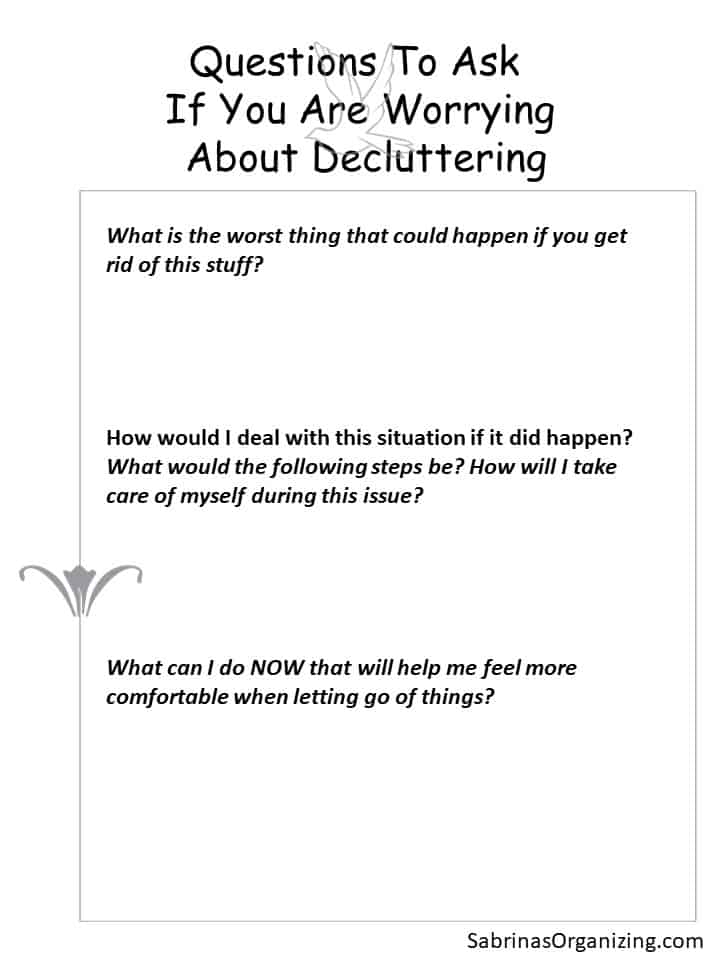
Questions to Ask Yourself If You Are Worrying About Decluttering
To help you overcome the fear and take action sooner, here are some questions to ask that will help you start clearing your clutter.
- What is the worst thing that could happen if you get rid of this stuff?
- How would I handle this situation if it were to happen? What would the following steps be? How will I take care of myself during this issue?
- What can I do NOW that will help me feel more comfortable when letting go of things?
Feel free to share this free printable.
These responses are different for everyone. What were your answers to these questions? Leave a comment below. I would love to hear from you.
I hope this post helps motivate you to clear the clutter in your home. If you need help, please get in touch with a Professional Organizer. Don't struggle on your own. Thank you for stopping by. Please share your questions and comments below.

Sabrina's Organizing Virtual Organizing Consultations
Struggling to get started and being accountable for your decluttering projects? Contact me today to explore my Virtual Organizing Services. I can help.
Get some additional decluttering advice from my blog!


Please note these are affiliate links through Amazon (affiliate), and at no additional cost to you, I will earn affiliate fees if you decide to make a purchase.





Janet Schiesl says
You have 3 great questions. I see people that don't consider what will happen - positive or negative - if they declutter and organize. Talking through what that will look like does help calm the anxiety people have before starting an organizing project.
Diane N Quintana says
When someone is struggling to get organized they get bombarded by the clutter shouting at them to take care of it and others (family members, partner, spouse) shouting at them - calling them names because they haven't dealt with the mess. Then the person can become riddled with doubt as to the best course of action.
I love the questions you pose and the guidance you provided your client. As someone else commented - as professional organizers we are in a unique position to shepherd our clients as they find new footing and get themselves as organized as is right for them.
Julie Bestry says
So many of the positive momentum in life (for getting education, for getting healthier, for getting organized) is stymied by other people's attitudes or even fear of what those other people will say. Constructive criticism can be helpful, but anyone whose comments keep you from moving forward are, as you are indicating, an obstacle. I love your printable for helping people do a little self-therapy to get past the worrying.
Stacey Agin Murray says
It's going to be much easier for your readers to start decluttering after downloading and using your printable! The true work of decluttering begins after pushing negativity and self-doubt aside and asking ourselves the important questions.
Sabrina Quairoli says
Thanks for stopping by and commenting, Stacey!
Jonda Beattie says
Buying into what others think rarely helps with getting rid of clutter and getting organized. People must think about what they really want for themselves - not what others want. Then they are free to make their own plans to get the job done.
Olive Wagar says
Your compassion for your clients is evident in what you write! I also appreciated the quote that clutter is a cry for help. As professional organizers, we have the unique opportunity to offer words of kindness, encouragement, and respect to each client. It may be the only positive words they hear.
Linda Samuels says
Clutter can become so overwhelming and paralyzing. And then, as you expressed, other factors kick in...like the negative self-talk, the worry, the letting go issues, the negative comments from friends and family. You've given a good framework to get started and move past that overwhelm. It often begins with asking some great questions. I like the ones you've suggested. Very often I find that even if a client is resistant to letting go at first, as they exercise their choices and letting go muscle, it becomes easier and quite freeing.
Nancy Haworth says
This is a great post. You are right, sometimes the defeatist attitudes of friends and family can make it difficult. I love your suggestion of setting a weekly recurring appointment with an alarm to remind someone to work on their home decluttering project.
Ellen Delap says
Great questions! It's true that worry is a big part of procrastination. It keeps you in paralysis. Processing these questions helps move you forward.
Maureen DeGarmo says
I like your interactive approach, complete with thought-provoking questions. My favorite is, "We don’t necessarily want the clutter but we also don’t know what to expect...."
Sarah Soboleski says
I love your quote "Clutter is a cry for help..." It's so true and so validating for many people. Definitely sharing!
Jill Robson says
I agree, Sabrina, people do not need the negative comments from family and friends, although they think they are helping!.
Janet Barclay says
It must have been so discouraging for your client's family not to believe in her. I must be careful not to treat other people that way.
Phoenicia says
I can happily live without clutter. I do not like mess of any sort but I have learnt to become tolerant as we have small children.
I take photographs of my children's pictures and work, keeping their most favourite.
I also have two storage boxes for each child with their first outfit/shoes/baby book and so on. This is their special box just for them.
My house rule is everything has its place. I like items to be kept in particular spots. It is less stressful when you need to locate something quickly.
I tidy as I go along so mess does not mount up to a one hour job.
Thank you for sharing this.
Susan cooper says
Clutter makes me feel nervous. I literally can't relax if my home is cluttered or in disarray until I get up and fix it. So you and I are on the same page. You have great ideas for those who need a nudge in getting started.