
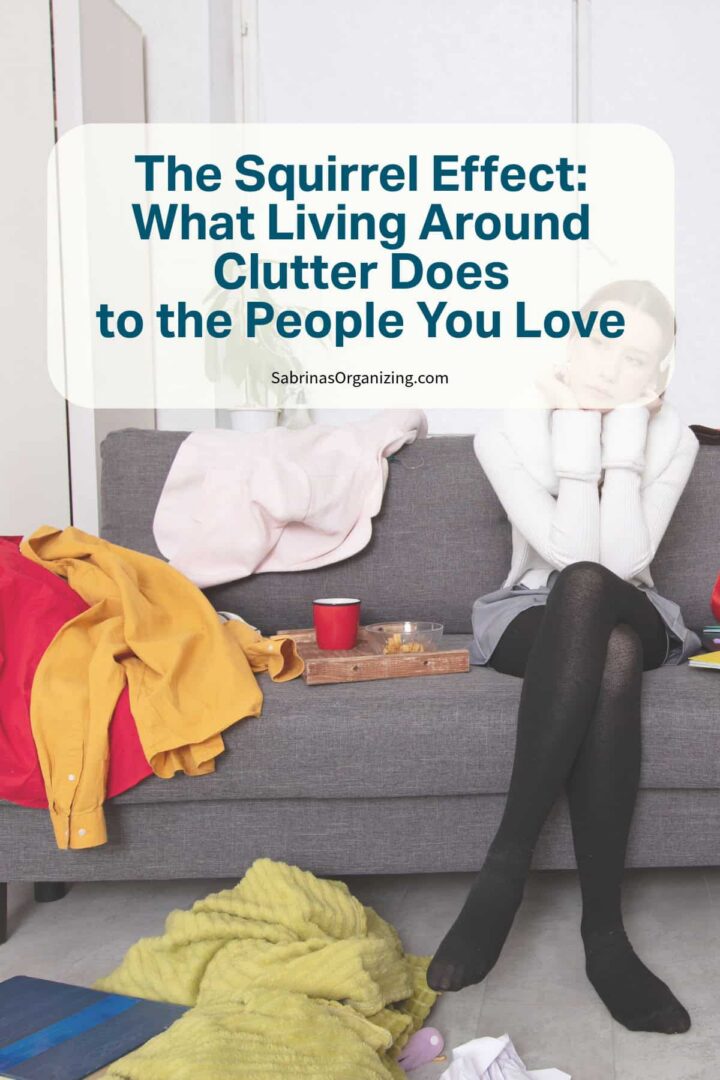
A few weeks ago, I was on my usual neighborhood walk when I noticed a squirrel up ahead. As I got closer, maybe 15 feet away, I watched this little guy grow frantic. He darted back and forth, unsure where to go, clearly bracing for something bad to happen. I never touched him, just looked at him from a distance. I just kept walking at my normal path, and by the time I passed, he'd bolted up a tree.
I had zero interaction with that squirrel. But just being near this cutie, just existing in the squirrel's space, was enough to put his whole body on high alert.
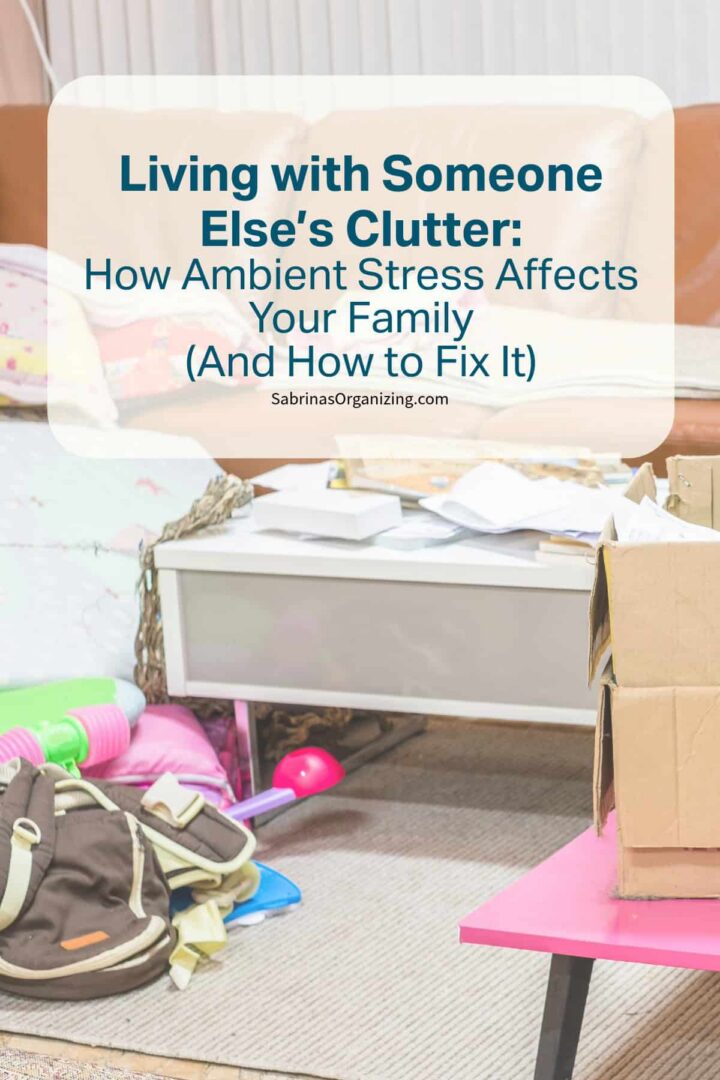
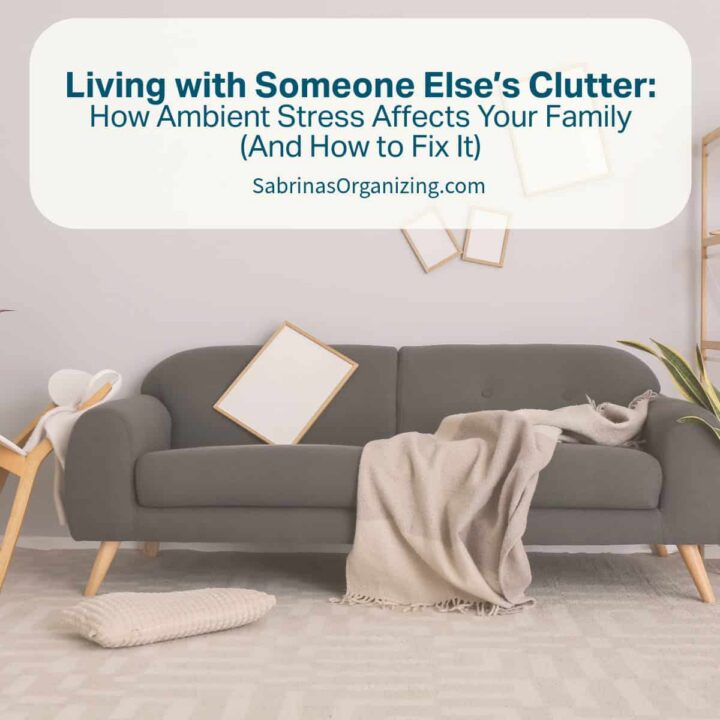
That stuck with me, because it's exactly what clutter does to the people who live with it. Let's talk about living with someone else's clutter and ways to gradually improve the situation.
Jump to:
Key Takeaways
- Living with someone else's clutter impacts shared space and increases stress for everyone involved.
- People don't have to own clutter to feel its effects, including anxiety, fatigue, and relationship tension.
- Children experience slower learning and behavioral issues due to clutter, making it crucial to address shared spaces.
- Gentle strategies can help alleviate the burden of clutter, such as isolating it and tackling it in small, manageable steps.
- Creating a calm space for children and using a professional organizer can ease the emotional toll of living with someone else's clutter.
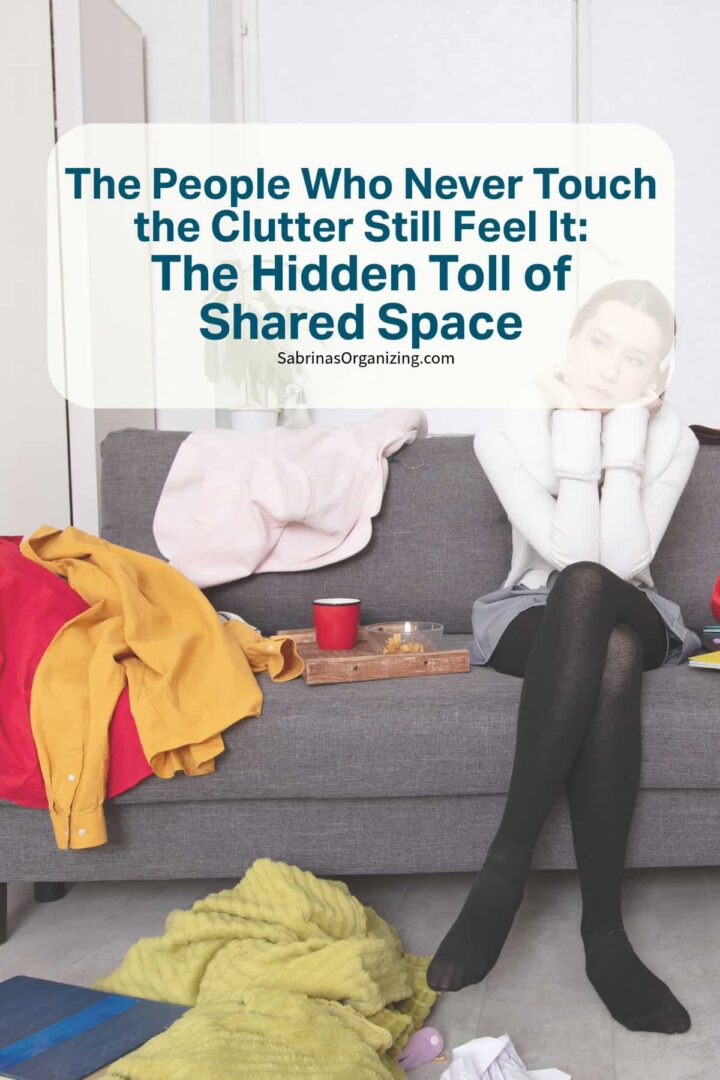
The People Who Never Touch the Clutter Still Feel It
As a professional organizer since 1997, I've spent almost three decades in other people's homes, and one thing has become impossible to ignore: you don't have to own the clutter to be affected by it.
A spouse who has nothing to do with the pile of boxes (affiliate) in the dining room. A teenager who never asked for the collection gathering dust on the shelf. A child who just wants a clear spot on the floor to play. None of them created the clutter. None of them have control over it. And yet they carry the tension of it every single day: the same low-grade, unspoken vigilance that squirrel felt just from me walking by.
Most of the research out there looks at how clutter affects the person who owns it - their stress, their decision fatigue, their relationship with their belongings. That's important work. But I think we're missing half the picture. What about the people who share the space but have no say in it? Is there a version of Al-Anon for people who love someone who over-collects, over-keeps, or can't let go? I think there should be, because what I'm seeing in homes tells me this deserves just as much attention.
What "Clutter" Actually Means Here
Before going further, I want to be really clear about what I'm not talking about.
This isn't about trash. It isn't about a busy kitchen counter on a Tuesday. It isn't hoarding, and it isn't a judgment on anyone's character.
The clutter I mean is anything sitting out, on display or not, that isn't being used, cared for, or engaged with the way it was intended and is just quietly collecting dust and decaying in place over time. It might be boxes (affiliate) stacked in the family room. It could be a "collection" on a shelf that hasn't been touched or dusted in years but still gets treated like a display. It's often confined to one shared space everyone in the house has to pass through or use, which is exactly why it affects more than one person.
Don't know if you have clutter in your home? Check out my How to Awaken from Clutter Blindness ebook to help!
How It Shows Up for the People Around It
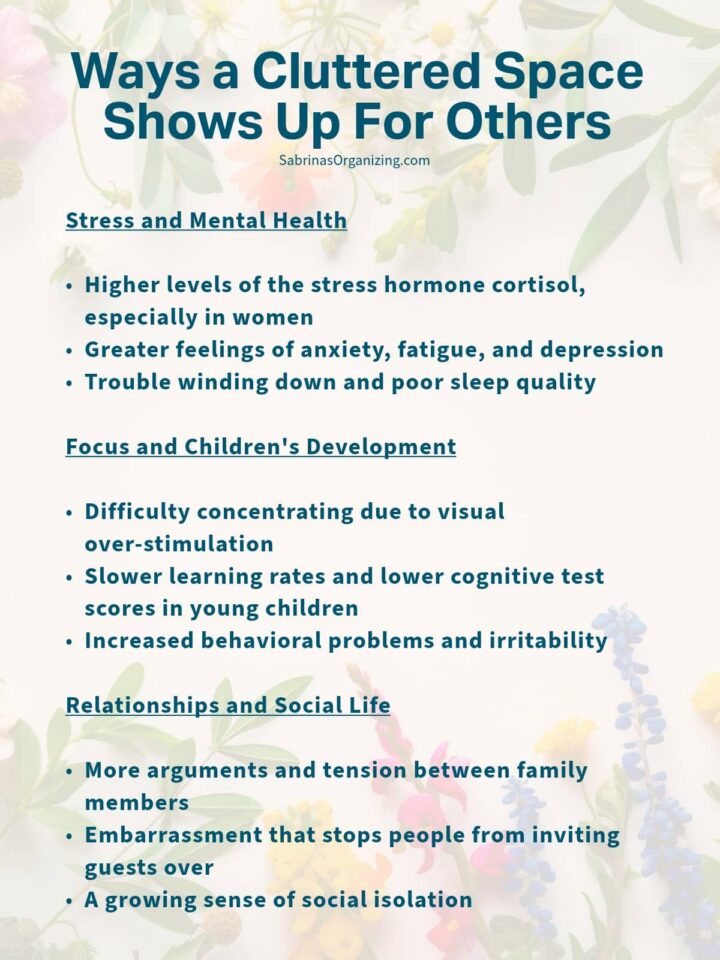
When someone lives in a cluttered space they didn't create and can't control, research points to some consistent patterns:
Stress and Mental Health
- Higher levels of the stress hormone cortisol, especially in women
- Greater feelings of anxiety, fatigue, and depression
- Trouble winding down and poor sleep quality
Focus and Children's Development
- Difficulty concentrating due to visual overstimulation
- Slower learning rates and lower cognitive test scores in young children
- Increased behavioral problems and irritability
Relationships and Social Life
- More arguments and tension between family members
- Embarrassment that stops people from inviting guests over
- A growing sense of social isolation
None of this means someone with clutter is a bad partner or parent. It just means the people sharing that space are absorbing an emotional cost they never signed up for, quietly, the way my squirrel absorbed the "threat" of a stranger just walking by.
Gentle Ways to Ease the Impact on Others
If this is resonating, please hear this next part clearly: this is not about shame. It's about small, doable shifts that protect the people you love while you work through your own relationship with your things, at your own pace.
1. Give the clutter its own room.
Instead of letting it spread through shared spaces, isolate it: an empty bedroom (affiliate), a corner of the garage (affiliate), a basement closet, an attic. This task alone can dramatically lower the "ambient stress" everyone else feels in the rooms they actually live in.
2. Sort by category, then label everything.
Group like with like, and label (affiliate) each box clearly - a label maker (affiliate) or simple printed labels (affiliate) work great. When contents are visible at a glance, the pile stops feeling like an unknown, unpredictable mass (which is a lot of what makes clutter feel stressful to others).
3. Commit to clearing one box a week.
Just one. It's a sustainable pace, and it sends a powerful message to the rest of your household: this is moving, this is temporary, progress is happening. That message alone can ease a lot of the tension. But, don't forget to donate the items or remove them from the house. All the reviewing and not taking action will show others nothing.
4. Bring in a body double.
A friend, a family member, or a professional organizer who sits with you while you sort can make an enormous difference. Having someone there to ask "does this still serve you?" helps you make decisions instead of getting stuck.
5. Try doing a "mystery box" yard sale.
Rather than digging through every item and second-guessing every decision, sell unopened boxes (affiliate) as-is for a flat rate, say $25 a box. It lowers the emotional friction of getting things out of the house.
6. Set up a mini shipping station.
If you're planning to sell things individually online, keep your shipping supplies (tape, labels (affiliate), boxes (affiliate)) right next to your computer (affiliate). When listing and shipping are frictionless, items actually leave the house instead of getting re-stashed in a "to sell" pile that becomes its own clutter.
A Gentler Way Forward
I keep coming back to that squirrel. He wasn't in any real danger. I never got closer than 15 feet, never reached for him, never even looked his way. But his body didn't know that. It just knew something big was near, and it reacted.
The people who live with clutter they didn't create are doing the same thing, every day, often without even realizing it. The goal isn't to fix everything overnight or to feel guilty about where you are right now. It's to start creating a little more breathing room for yourself, and for the people quietly bracing beside you.
I hope my post about living with someone else's clutter helps you see how much your surroundings impact others.
Let's continue the conversation: do you deal with clutter each day? How does it affect you? What do you do to support your mental health? Are you the person creating the clutter? How would you like to change your patterns? Please leave a comment below. No judgment here. We are here to support you.
Struggling with a cluttered home? Looking for nonjudgmental support to help you get over the obstacles? Check out my Virtual Organizing Consultations and contact me so we can discuss your specific situation.
Frequently Asked Questions
Yes. Research shows that people sharing a cluttered home, even without any responsibility for the clutter itself, experience measurable increases in stress hormones, anxiety, and relationship tension, along with lower sleep quality and, in children, slower learning and increased behavioral issues.
No. Clutter in this sense doesn't require a hoarding disorder or even a large volume of belongings. It can be as contained as one shelf, one collection, or a few boxes in a shared space that never get used, cared for, or cleared.
Focus on shared spaces and pace rather than possessions and blame. Isolating clutter to one area, tackling a single labeled box per week, and bringing in a neutral third party (like a professional organizer) all create momentum without confrontation.
Children are especially sensitive to visual overstimulation from cluttered shared spaces, which research links to difficulty concentrating and increased irritability. Creating even one clear, calm space for them-a bedroom, a play corner-can meaningfully help, even before the rest of the home is addressed.
Related Posts:
Full Disclosure: Creating this article I used my thoughts, AI's assistance, and these wonderful sources referenced: How Hoarding Impacts Families, How HD Affects Families, The Social Effects of Clutter, A Cluttered Home Causes More Stress for Women Than Men




Janet Barclay says
This has never been an issue for me, fortunately, except for one teenager who complied with my request that he limit his clutter to his own room. However, I know someone who has dealt with her partner's clutter for decades, and have seen how frustrating it can be. She's managed to get things in better control by dealing with specific areas, one at a time, over the years.
Sabrina Quairoli says
Thanks for stopping by and leaving a comment, Janet.
Julie Bestry says
I couldn't agree more. Clutter impacts the people who own the clutter (even if they don't recognize it) and the people whose clutter it isn't (even if they don't complain about it).
Everything you've laid out is definitely the gentle approach to tackling your own clutter, but it leaves aside the issue of dealing with the squirrels who won't let anyone lessen their clutter. They get skittish because they are not accepting of anyone touching their clutter, nor do they (sometimes) even admit what you've shown so clearly here, that clutter impacts those who have to live with it. These people may (indeed are) negatively impacted by their own clutter, but it can be hard for their loved ones to get them to consider making any changes. They want to spread out, they want to pile things up; and again, these aren't people who hoard, but people who don't admit to a desire to improve. Unfortunately, this is at the heart of so much stressful discussion/fighting between couples, or (of less power and duration, parents and teens). Even asserting the necessity of step #1 (and saying, "Have all the clutter you want, but not in the public spaces of the house; your clutter is limited to YOUR room or X room") can lead to conflagrations.
It comes down to the necessity of *mutual* kindness, compassion, and communication as the first step when wanting to live without someone else's clutter, and self-compassion as well, for reducing your own in order to be kind to the ones living with your clutter until you reduce it.
Thank you for tackling such a complex, nuanced topic!
Sabrina Quairoli says
Thanks for stopping by and leaving a comment, Julie. I really appreciate it.
Pam Holland says
Thanks for outlining all the ways that maybe someone else's clutter has an impact on everyone in the household.
Jonda Beattie says
Thank you for taking on this perspective. It is not often that we work with how clutter affects everyone in a home. I think that there is a clutter blindness as well so that they really don't even realize why they are feeling the stress. Identifying what is the clutter is the first step and then making a plan for how to deal with it in small bites is a great idea.
Sabrina Quairoli says
I agree, Jonda. People in the midst of the clutter honestly just don't know that others could be struggling. It's an important awakening people need to see to motivate themselves to finish tasks, declutter, and get organized. Thanks for stopping by and joining in the conversation.
Diane Quintana says
This is a great perspective, Sabrina. You are correct. Clutter in a home has an affect on every person living there - even the person collecting the things. It also affects each person differently.
I agree sorting the accumulation takes time and it's best done by grouping similar things together. Assigning a time period to get a little done at a time is a good idea.
Sabrina Quairoli says
Thanks, Diane, I really appreciate your comment. =)
Kimberley Tremblay says
Hi Sabrina, I think its so important to talk about how it affects others in the home. And you have done it in a kind and compassionate way. I have a number of people I work with who are in this situation and its so hard for them to move on with their own goals and possibilities (for their home and life too)
Sabrina Quairoli says
Aw, thanks, Kim. I really appreciate you stopping by and leaving a comment. It is much appreciated.
Linda Samuels says
The psychological effects of clutter are real, and there is extensive research (as you mentioned) to support this. You've highlighted a different, equally important aspect: the effect of your clutter on someone else in the household who has no ownership or control over it.
Bringing the squirrel into the story is an interesting correlation. Because picturing a scared and anxious squirrel is something many of us are familiar with. The movement and behavior you described are something I've seen many times. With people, it might not be as overt, but the internal dynamics could be similar.
Awareness and conversation might be a great first step. Then, implementing some of the strategies you suggested to help declutter can also be valuable. In any household where people share space, it's helpful to have boundaries and to be able to discuss these issues. It's not always easy, but still important to do for better household harmony.
Sabrina Quairoli says
I totally agree, Linda. Thanks for stopping by and joining in the conversation. It is much appreciated.
Seana Turner says
This is such an important topic. I think your story about the squirrel really explains that level of alertness and unsettledness that clutter brings about. We don't even realize it is stressing us out! When it is caused by someone else, we experience a deep sense of anxiety because we don't feel empowered to fix it.
It's so important for family members to be aware of the fact that their treatment of their things can really be impacting others who share space to them. I see this with couples all the time.
You make great suggestions. If possible, I suggest clients agree to keep the "public spaces" decluttered, and then allow family members to keep their private spaces more as they wish. This isn't always possible in small spaces, though, and of course, dealing with the clutter is always the top priority.
Important topic today!
Sabrina Quairoli says
I totally agree, Seana. Thanks for your insightful words. It is much appreciated.