
Small home organizing tasks each day will add up over time. If you only do 15 minutes of organizing each day, you will have done an hour and 45 minutes per week; if you do it for one month, you will have done 4.5 hours. If you do it every day for the entire year, you would have done 54 hours per year of organizing. WOW! But, to do this, you will need to do some planning. You need to find things that you can do to not only clear out the room but also maintain the space so as not to allow any new piles to form. In this post, I will talk about tasks that you can do to not only get rid of clutter but also keep the clutter at bay. Come along for the ride. I've updated this post for 2026 with additional creative ideas I have used over the years since writing it.
Jump to:
- Key Takeaways
- 1. Trash cans only help if you use them.
- 2. Piles are only helpful if each collection has a common topic or theme.
- 3. An organized process in place doesn't have to be magazine beautiful.
- 4. Labeling is only necessary if you can't see what is inside the container or bin.
- 5. For frequently used items, have a daily drop spot for everyone to use.
- What to Keep in Your Organized Entryway Landing Zone
- Step By Step Entryway Organization
- Before and After: Foyer Organizing Kid's Backpacks and Activity Supplies
- 6. Stay consistent when putting stuff away; you will never be disorganized.
- 7. Create a donation pile corner in the garage.
- 8. Have stair bins to store items that need to go upstairs or downstairs.
- 9. Set a 10-minute reset timer before bed.
- 10. Do a weekly "one-drawer" check instead of a big declutter day.
- 11. Use your phone's reminders app as a mini organizing coach.
- Frequently Asked Questions
Key Takeaways
- Small daily organizing tasks accumulate; just 15 minutes each day totals 54 hours a year.
- Creating an effective organizing system varies for each person, and it's essential to find what works for you.
- Use trash cans (affiliate) correctly, create themed piles, and maintain an organized process that suits your lifestyle.
- Consistency is key (affiliate): return items to their designated spots and set donation corners to keep clutter at bay.
- Implement simple strategies, like weekly drawer checks and using your phone's reminders, to keep your home organized.
First, understand that organizing a space isn't the same for everyone. There are some similarities, but every person is different. Everyone has their own way of doing things and assessing their situation. They also have their way of finding solutions. I've worked with several people over the years, and I've found that each person comes to a slightly different conclusion about their organizing systems. And that is OK. Each of us has to determine what works for us. One person, even a Professional Organizer, can't force their viewpoint on another, which is the case with creating organized systems in a home. However, there are some specific tasks you can keep in mind that will help a room stay organized longer and make you less overwhelmed by the messiness of the home.
1. Trash cans only help if you use them.
If you have a trash can (affiliate) in your bedroom (affiliate) and tissues and other things lying on different surfaces, you are not using the tool intended for that purpose. Over the years, I have found that people keep trash-really, garbage! Not for any reason, but they just stop before completing the task of throwing something away.
2. Piles are only helpful if each collection has a common topic or theme.
Some people are visual and may need to see what they need to do to remember the 'to-dos.' That is OK. However, you need to have a system associated with these piles. For example, one collection could be for bills to be paid. One pile can be for papers you want to read before taking action. One pile can be for papers you want to read before taking action. Before making a collection, ask yourself to define the theme for the pile. Using a sticky note, write on it what action you need to do with this pile. When you add to the collection, move the sticky note to the top.
3. An organized process in place doesn't have to be magazine beautiful.
We all love how magazine homes look - perfectly displayed books and strategically placed figurines with no clutter to be cleared in the house. Well, that doesn't happen in real life, sorry to say. Systems need to be in place to make a home work truly. So, don't worry about the perfect look. Just make sure the room works for you.
4. Labeling is only necessary if you can't see what is inside the container or bin.
Labeling is essential, especially if you have other people using a space. However, if your system is well thought out and you know where everything is, you don't need labels (affiliate) on every single bin, especially if the bin is clear. Seeing through the container makes it easy to quickly see what is inside.
5. For frequently used items, have a daily drop spot for everyone to use.
We use a table in the entryway that holds chargers because no one will leave without their cell phones. If you want to use a closet, try including the charging station (affiliate) inside the closet with cubbies for shoes (affiliate) and hooks for bags. Staying consistent will minimize lost items, like keys(visit our post about how to organize your keys), when you are rushing out the door.
Visit our other posts about entryway drop zones.
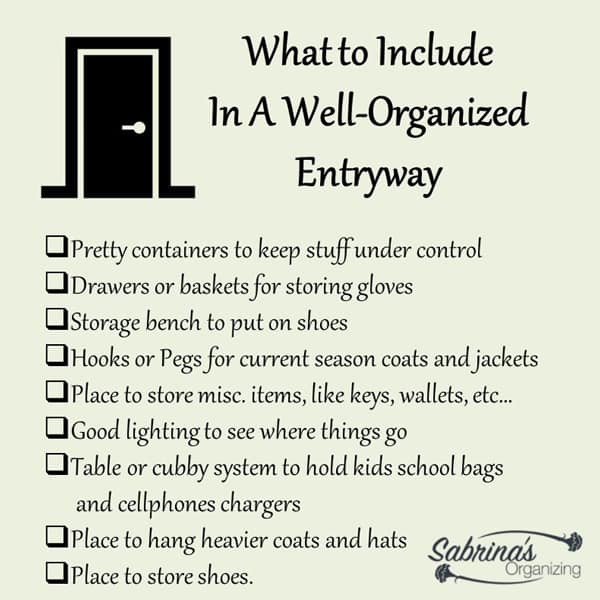
What to Keep in Your Organized Entryway Landing Zone
Is your entryway a mess? When you enter your home, are there piles of things lined near the door? This area is called the entryway landing zone or drop zone. In this area, you place items that will be going out of the home with you and your family. It is an area that can
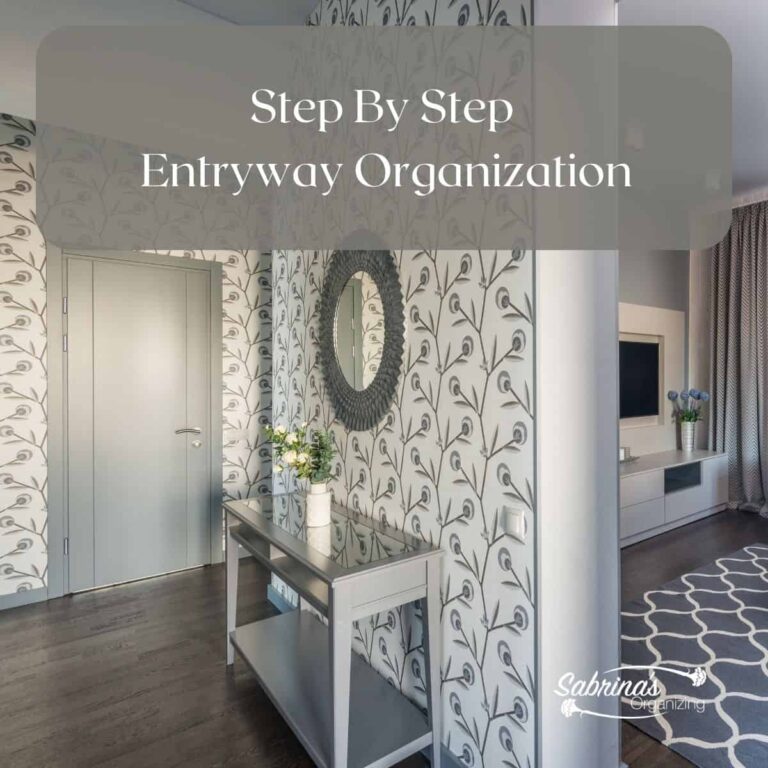
Step By Step Entryway Organization
When you enter your home, where do you place your stuff? Do you throw your coat over a chair? How about your bag? Do you place it on a nearby table? And, your shoes, do they end up near the front door in a pile?
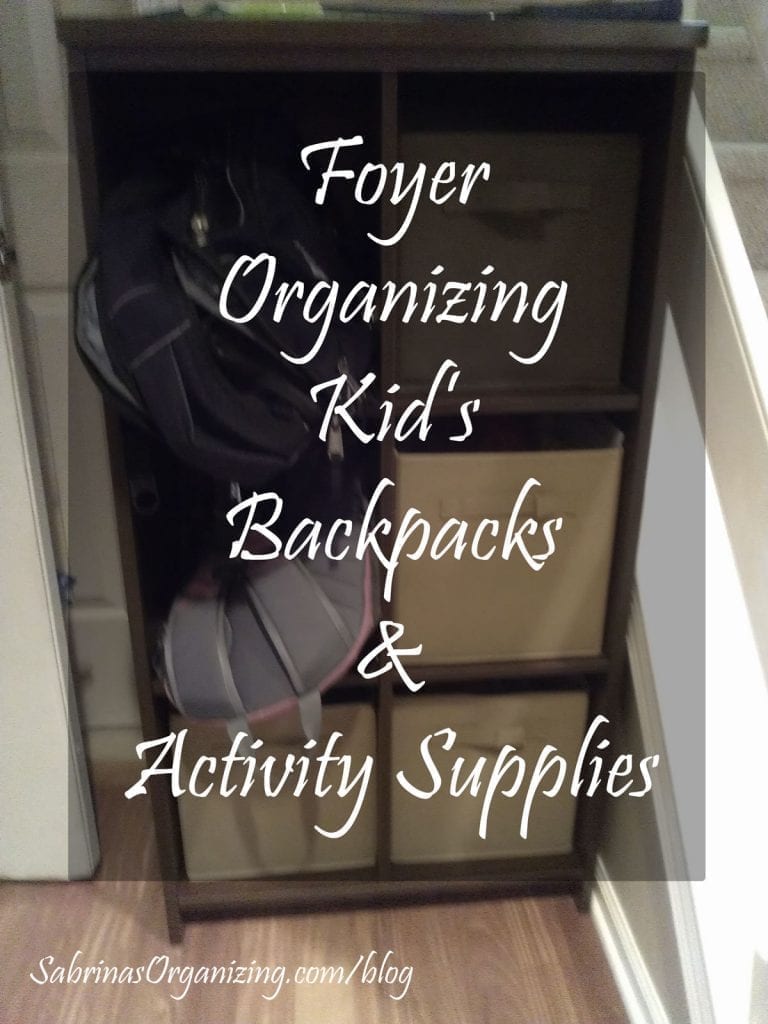
Before and After: Foyer Organizing Kid's Backpacks and Activity Supplies
Like most parents, my kids are in after-school activities as well as activities during the school day, so to make my foyer a little neater and my kids' stuff a little more organized, I wanted to create a space for them.
6. Stay consistent when putting stuff away; you will never be disorganized.
When we take stuff out and don't return it to its home, it can get messy quickly. Creating systems does help. Creating habits to return things to their homes will keep the system working for as long as you need it. Decide when you feel the most productive in your day. Pick that time to spend returning items to their homes. Some people like to do this at the end of each day. Some prefer doing it at lunchtime. Others prefer to do it in the morning when they wake up. There are two benefits of doing this each day.
- You will always be able to find your stuff.
- You will know when something is missing.
7. Create a donation pile corner in the garage.
A garage (affiliate) or basement is a perfect place to add a donation corner. Keeping these items near the door and donating items each month or quarter will minimize the mess in the home. Adding a reminder to your calendar that says "bring things to donate" will keep you decluttering.
8. Have stair bins to store items that need to go upstairs or downstairs.
Do you have more than one floor? Maybe it's time to add bins to the steps. Using small bins and labeling them for each family member will help you delegate the task of clearing out items on the main floor. Check out my post about it. HOW TO USE CATCH-ALL BINS TO STAY ORGANIZED.
9. Set a 10-minute reset timer before bed.
I know, you are too tired. But a 10-minute reset before you turn in makes the next morning so much easier. Set a timer on your phone (or your Alexa/Google speaker, if you use one) and do a quick lap around the main floor: cups to the sink, shoes (affiliate) to the closet, mail into its pile.
Small tip: keep a basket by the stairs (like the stair bins mentioned above) so anything that needs to go up gets tossed in during your reset instead of carried one item at a time.
10. Do a weekly "one-drawer" check instead of a big declutter day.
Big decluttering days sound great in theory, but they rarely happen consistently; life gets busy. Instead, pick one drawer, shelf, or bin each week and give it 5 minutes. Rotate through the house room by room.
By the end of the month, you've touched most of the "problem spots" without ever blocking off a whole Saturday. A small caddy (affiliate) makes it easy to corral loose items you find along the way until you decide where they belong.
11. Use your phone's reminders app as a mini organizing coach.
This one's simple but works so well. Set a recurring reminder, "empty the entryway bin," "check the donation corner," "clear the counter pile" for whatever spot in your home tends to get messy first. You don't need a fancy app. Your phone's built-in reminders work just fine, and having the nudge pop up removes the mental load of remembering to check.
Frequently Asked Questions
Just 10-15 minutes a day is enough to maintain an organized home once systems are in place. It's consistency, not time, that makes the biggest difference.
Start with the trash can tip make sure every room has one and actually use it. It sounds small, but it clears the easiest clutter first and builds momentum for bigger habits.
No. Labels only matter if you can't see what's inside a bin or if other family members share the space. Clear bins often don't need labels at all.
Keep systems simple and visible: daily drop spots, labeled stair bins, and consistent "homes" for items make it easy for everyone to participate without extra reminders from you.
That's normal! Just restart with one small task, like the 10-minute reset. You don't need to overhaul everything at once; pick back up where it's easiest.
Above all else, when determining your process, look at the big picture and decide not only what you want to organize but also how you would maintain it. Remember, it's not all about the organization. I hope this post inspires you to get your home organized for good.
Looking for even more inspiration on keeping your home organized? Check out these other experts' articles.
Please note these are affiliate links through Amazon (affiliate), and at no additional cost to you, I will earn affiliate fees if you decide to make a purchase.
Want more ideas? Visit our posts about organizing small homes.

Janet Schiesl says
It's always so great having tips that aren't time consuming but that add up to great outcomes.
Julie Bestry says
They may be quick tips, but they are tiny bits of organizing magic.
I've seen crumpled bits of papers, used envelopes, tissues, paper cups and napkins, etc., just sitting on surfaces because the trashcan went unused. Perhaps because it was unlined (and the person knew they'd have to dump it out eventually), perhaps because it was too small (and they'd have to go to the labor of emptying it. But each space needs a place to collect what's going away (similar to your donation bin comment, as well). All of this advice is practical but so simple to employ! And let's face it, some people will always be pilers, but keeping one category to each pile will at least apply a systematic approach so things can be found again. It's a start!
Jonda S Beattie says
I especially like the being consistent when putting things away. I am always telling my clients, "Don't put it down. Put it away."
Sabrina Quairoli says
Great phrase, thanks for sharing, Jonda!
Linda Samuels says
I appreciate how that advocated that there isn't a one-size-fits-all approach to being, feeling, or getting organized. You beautifully described some solid organizing strategies and principles, which are helpful. They can also help identify what's not working. For example, perhaps someone has many items to let go of and donate, but those things are spread around the house and create cluttered rooms. Your suggestion to contain the donations in a single, known area (i.e., garage, attic, or closet) is an excellent solution.
Sabrina Quairoli says
Thanks for commenting, Linda!
Diane Quintana says
These are fabulous, Sabrina. My favorite is the trash can tip. I so agree. I can't tell you how many times I've been in a home where there is an empty trash can in the corner of the room and little bits of trash here and there. Trash cans are only good to have if you use them (and empty them) regularly!
Sabrina Quairoli says
Thank you for commenting, Diane!
Seana Turner says
I pretty much find trash in every space I organize. Common culprits are empty cups, twist ties and clothing labels (along with the plastic ties that hold them in place.) If a trash can isn't nearby, it can be so much easier to simply "stick it" on a shelf or surface. Getting the can into the space is step one, and then - as you point out - we've got to use it!
Linda Samuels says
Small moments definitely add up. I like the math calculations here that quantify what can be accomplished within a year on only a 15-minute a day effort. This is a great point because organizing can feel so overwhelming to some, but with some regular maintenance effort, it becomes doable to keep systems working.
Kim says
I love the sticky note idea. You think you will remember what your plan was with the pile (papers, for example) but it is easy to forget and then it all gets mixed in with the mess. I will try this myself with my desk. I can just see myself going through the pile and then its "oh yeah, I need to do that as well". I also tend to do a few things while waiting for the kettle to boil which is always a good use of time.