
This month, I turn 55. And like any good professional organizer, I couldn't just celebrate without reflecting, sorting, and making a list.
I've been organizing people's homes and lives since 1997, and before that, I was organizing my own bedroom (affiliate) as a kid with immigrant parents who were brilliant entrepreneurs, but let's just say, organizing wasn't their superpower. So I figured it out myself. Through trial and error, through five dogs, two kids, a college essay written at Dunn's River Falls, and nearly three decades of client work, I've collected more than a few lessons.
Here are 55 organizing lessons learned, one for every year. I hope at least a few of them resonate with you.
Jump to:
- Key Takeaways
- Organizing Lessons I Learned as a Kid (Ages 1-12)
- Organizing Lessons I Learned as a Teenager (Ages 13-17)
- Organizing Lessons I Learned in My Early Adulthood (Ages 18-29)
- Organizing Lessons I Learned as a New Mom (Ages 30-39)
- Organizing Lessons I Learned as a Professional Organizer (Throughout My Career)
- Lessons I've Learned About Life and Mindset
- What Organizing Lessons Have Stuck With You?
- FAQs
Key Takeaways
- At 55, the author reflects on 55 organizing lessons learned throughout life, emphasizing that everything needs a home.
- Early lessons focus on returning items to their designated spots and organizing by category for clarity.
- As a professional organizer, the author emphasizes that clutter reflects postponed decisions and that systems require regular maintenance.
- The author underscores the importance of asking for help, taking care of oneself first, and involving kids in organizing tasks.
- Ultimately, organizing is a skill that can be learned at any age, reflecting personal growth and life's transitions.
Organizing Lessons I Learned as a Kid (Ages 1-12)
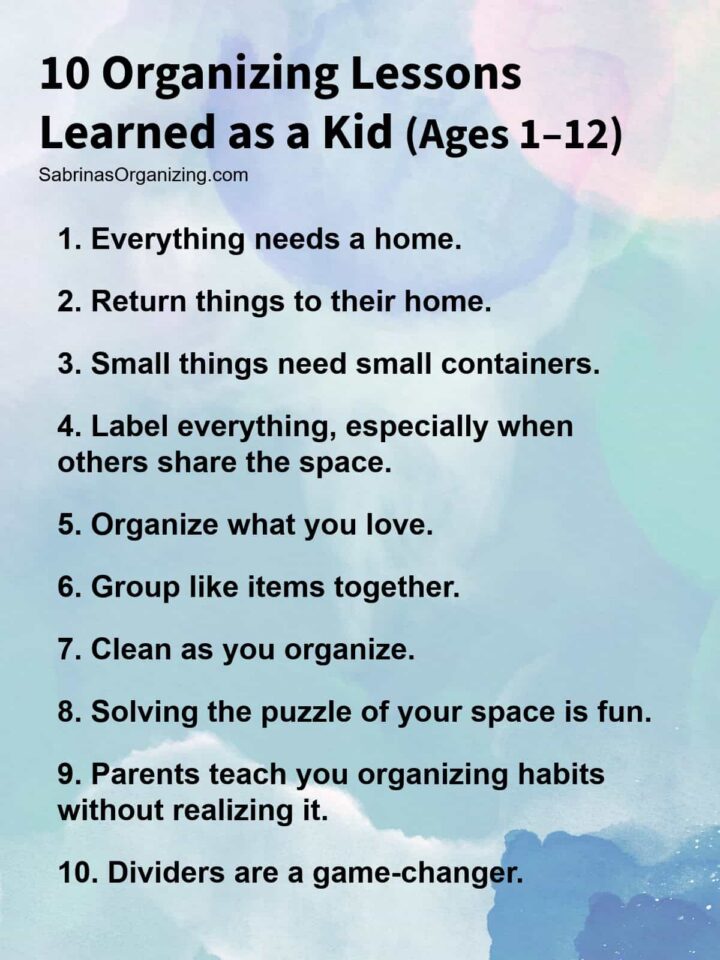
1. Everything needs a home. If something doesn't have a designated spot, it will wander, and you'll spend your life hunting for it. I learned this early when scissors (affiliate) for coupon-cutting would go missing every single week.
2. Return things to their home. Having a home for something means nothing if you don't put it back. This was one of the first organizing habits I developed as a child, and it still holds true today.
3. Small things need small containers. Mixing pushpins and paper clips together isn't just disorganized, it's a hazard. Keep small items separated into their own bins.
4. Label (affiliate) everything, especially when others share the space. It may seem like overkill, but when four people share a home, and no one knows where anything belongs, labels (affiliate) are the great peacekeeper.
5. Organize what you love. I sorted my craft supplies in my bedroom (affiliate), not because someone told me to, but because I loved crafting and wanted easy access to my things. Organizing feels less like a chore when it serves something you care about.
6. Group like items together. Sort by category. It is so much easier to find things when there's a common theme tying a group together.
7. Clean as you organize. When clearing out a drawer, take everything out, wipe up any crumbs on the bottom, and put back only what you want to keep. I learned this one early, and it's become second nature.
8. Solving the puzzle of your space is fun. I treated organizing like a puzzle as a kid; figuring out how things fit together was a game, not a chore. That mindset has stayed with me.
9. Parents teach you organizing habits without realizing it. Even when my parents weren't organized, the gaps they left taught me what I needed. Sometimes what's missing shows you the way.
10. Dividers are a game-changer. Whether in a school binder (affiliate) or a kitchen drawer (affiliate), dividers keep categories separate and save you from rummaging. I discovered this in middle school and never looked back.
Organizing Lessons I Learned as a Teenager (Ages 13-17)
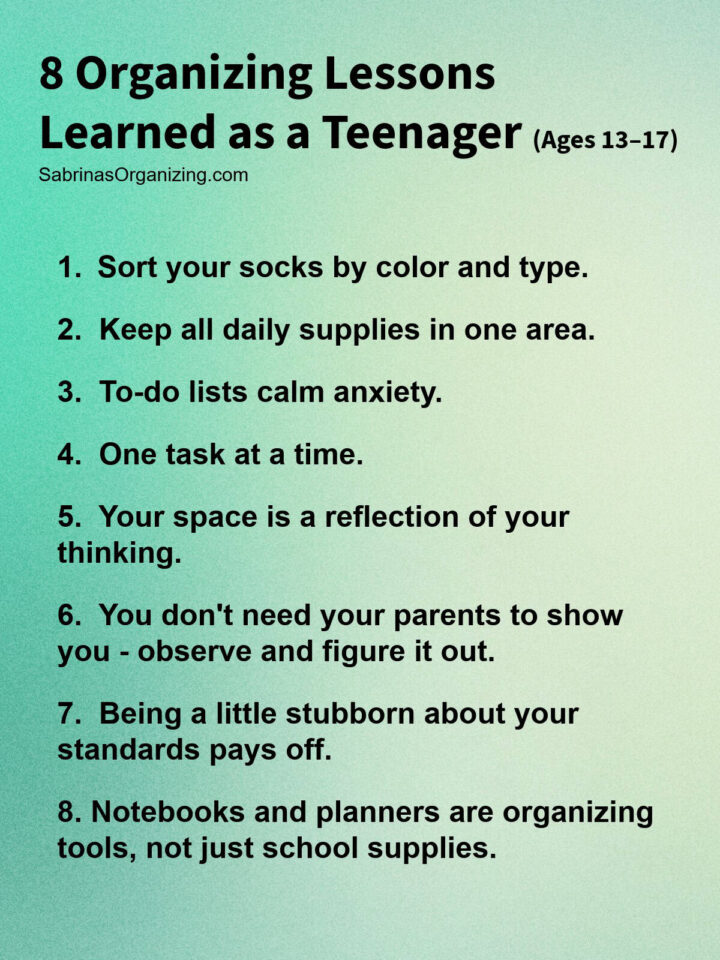
11. Sort your socks by color and type. This sounds small, but when you can grab the right sock on the go without hunting, you'll understand. Divide by black (affiliate), white, work, tights, whatever works for your life.
12. Keep all daily supplies in one area. Whether it's a purse, a binder (affiliate) pocket, or a carrying case, when everything you need is in one place, you stop losing things.
13. To-do lists (affiliate) calm anxiety. When I started feeling overwhelmed about everything I needed to do, I'd write it all down before bed. It got the noise out of my head and helped me actually sleep. This habit has been a lifesaver ever since.
14. One task at a time. Finish what you're doing before moving to the next thing. Write down the next step so you don't lose your place, then stay focused.
15. Your space is a reflection of your thinking. When my space was chaotic, my mind felt chaotic too. Organizing my room gave me a sense of control I couldn't find anywhere else as a teenager.
16. You don't need your parents to show you - observe and figure it out. Nobody handed me an organizing system. I watched, noticed what frustrated me, and fixed it. You don't always need a teacher to learn.
17. Being a little stubborn about your standards pays off. Once you know how you want something organized, hold that standard. Don't let the drawer become a catch-all again just because it's easier in the moment.
18. Notebooks and planners are organizing tools (affiliate), not just school supplies. Having all my homework, activities, and tasks in one place was one of my biggest productivity breakthroughs in high school. One home for all the things.
Organizing Lessons I Learned in My Early Adulthood (Ages 18-29)
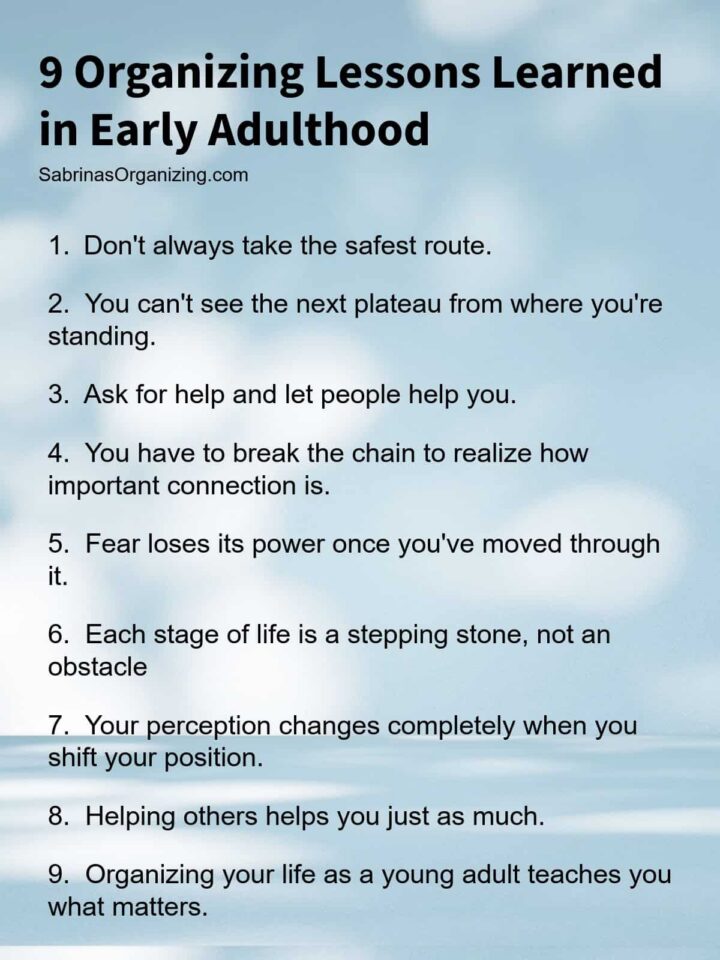
19. Don't always take the safest route. My parents told me this when I hesitated at the bottom of Dunn's River Falls in Jamaica. I was nervous, clinging to the shore. But climbing that waterfall changed how I see challenges. The safest path often costs you something beautiful.
20. You can't see the next plateau from where you're standing. When I started up those falls, I couldn't see past the first level. Life is the same way. You will not know what's ahead until you actually start moving.
21. Ask for help and let people help you. At the top of those falls, strangers had become a team. Everyone was helping each other move forward. I learned that asking for help isn't a weakness, it's smart.
22. You have to break the chain to realize how important connection is. On the falls, when someone let go, everyone stopped. The same is true in life and in any organizing project; support systems matter.
23. Fear loses its power once you've moved through it. Standing at the top, looking down at the falls that had terrified me, they looked completely different. Fear (affiliate) is a matter of perspective, and it changes when you act despite it.
24. Each stage of life is a stepping stone, not an obstacle. The climb had plateaus, each one preparing you for the next. Life and decluttering work the same way. You're not behind. You're on a plateau.
25. Your perception changes completely when you shift your position. From the bottom, the falls looked terrifying. From the top, they looked inviting. This is true for clutter, for challenges, for hard conversations. Your view from the top is always different.
26. Helping others helps you just as much. One of my dogs, Misty, stood guard over my newborn kids without being asked. Giving care to others creates purpose and steadiness in your own life.
27. Organizing your life as a young adult teaches you what matters. When you're on your own for the first time, you discover what habits actually support your life and which ones you were doing out of habit or fear (affiliate) of letting go.
Organizing Lessons I Learned as a New Mom (Ages 30-39)
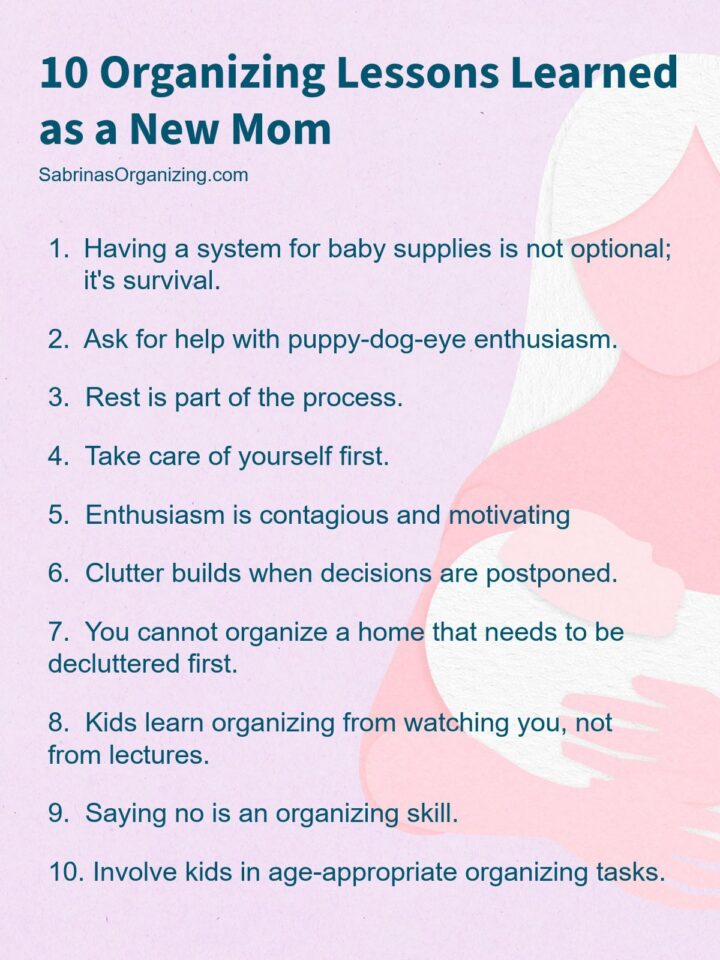
28. Having a system for baby supplies is not optional; it's survival. When you're running on no sleep, knowing exactly where the diapers, burp cloths (affiliate), and baby Tylenol are is everything. Systems aren't a luxury for parents; they're life support.
29. Ask for help with puppy-dog-eye enthusiasm. My dog Buster would sit by the door and wait, wide-eyed, until someone noticed he needed out. There's something to be said for asking clearly and letting people help. Don't suffer in silence.
30. Rest is part of the process. My dog Missey was content. She rested when she needed to and moved when she was ready. She never forced more than she needed. I've had to learn and re-learn this one.
31. Take care of yourself (affiliate) first. You cannot organize a home, raise children, and run a life on empty. Whatever refills you, a walk, a quiet morning, a morning ritual; protect that time. I have been walking every day, rainy, sunny, and snowy days, and it was a game-changer.
32. Enthusiasm is contagious and motivating. Even when you don't feel like tackling that closet, bring a little energy to it. As my dog Buster showed me every time we went outside, enthusiasm transforms a task.
Clutter Builds when Decisions aren't made.
33. Clutter builds when decisions are postponed. Every item in a pile represents an unmade decision. Clutter is really just indecision made visible. When you make the call, keep, donate, toss, the pile disappears.
34. You cannot organize a home that needs to be decluttered first. This is something I tell every client. You cannot organize chaos. Pare down first, then find systems.
35. Kids learn organizing from watching you, not from lectures. The best thing you can do is let them see you put things back, make decisions out loud, and treat your home with care.
36. Saying no is an organizing skill. Every yes to one thing is a no to something else, including your time, your space, and your sanity. Saying no is how you protect the life you're trying to organize.
37. Involve kids in age-appropriate organizing tasks. Even toddlers can put blocks in a bin. Teaching organizing skills early gives children a sense of ownership and confidence over their space.
Organizing Lessons I Learned as a Professional Organizer (Throughout My Career)
38. Stay focused on the goal. Fritz, my first dog, was relentless when chasing a fly - headfirst into the wall if needed. In an organizing session, know your goal before you begin. Distraction kills momentum.
39. Everyone has a different organizing style, and that's okay. What works for one person's home is chaos for another. My job is to find the system that fits the person in front of me, not the one from the magazine.
40. The first 20 minutes are the hardest. Once you start, the momentum builds. The resistance is almost always at the beginning. Just start.
41. Empty the space first. You cannot organize what you cannot see. Take everything out, clean the surface, then rebuild with intention.
42. Organizing is a process, not a one-time event. Life changes. Families grow. Jobs shift. A system that worked beautifully last year may need adjusting today. Build in regular maintenance.
43. Be patient and stubborn about your goals at the same time. My dog Tommy would wait patiently, stubbornly, for the one specific meal he wanted, without giving in. Know what you're working toward and don't settle for less, but give the process time.
44. Low click-through doesn't always mean bad content; it might mean a title problem. (Yes, this applies to organizing your blog, too.) lol If something good isn't getting noticed, look at how it's being presented before assuming the thing itself is broken.)
Believe in Yourself And What You Accomplished
45. Your credential matters; use it. As a NAPO professional organizer, I bring real expertise to my clients' homes. Don't undersell your experience. You've earned it.
46. Helping someone organize their home changes their life. I've seen it hundreds of times. When a space gets cleared, something shifts inside the person. The clutter was never just about stuff.
47. The system has to work when you're tired, distracted, and in a hurry. The best organizing systems aren't the prettiest; they're the most realistic. If it takes too much effort, you won't use it.
48. Procrastination is fear (affiliate) in disguise. Whether it's a cluttered room or a difficult conversation, procrastination usually comes down to fear (affiliate) of the decision, the effort, or the feelings underneath. Name the fear (affiliate), then start anyway.
Lessons I've Learned About Life and Mindset
49. Courage is what makes every other virtue possible. Maya Angelou said it best: without courage, you can't practice any other virtue consistently. Organizing your home takes courage. So does decluttering your relationships, your schedule, and your habits.
50. Action is what makes dreams real. Wishing your house were organized won't make it so. Putting one item away starts the chain reaction. Action is the only thing that counts.
51. You are responsible for your own life. No one else is going to come along and sort out your home, your schedule, or your mindset. That responsibility - and that power - is yours.
52. Your thoughts shape your reality. Negative thinking keeps you stuck. When clients tell me, "I'm just not an organized person," I always push back: that's a thought, not a fact. Change the thought, change the outcome.
53. The lessons come when you're not expecting them. My most powerful organizing insights didn't come from a course or a book; they came from my parents, my dogs, my kids, a waterfall in Jamaica, and many clients who showed me what was possible.
54. Turn your wounds into wisdom. Things I found hard, embarrassing, or painful have become my best material. The messy stuff is where the real lessons live.
55. Every stage of life has something to teach you, if you're paying attention. At 55, I'm not at the top of the falls yet. I'm still climbing. But I know how to hold someone's hand, help the person in front of me, and trust the person behind me. That feels like enough.
What Organizing Lessons Have Stuck With You?
I'd love to hear which of these resonated or what lesson from your own life I should add to the list. Drop it in the comments below. After all, we're all figuring this out together. I hope these organizing lessons I learned help you, too.
FAQs
The most important organizing lessons come down to three things: everything needs a home, return items to that home consistently, and declutter before you organize. Beyond the physical space, the biggest life lesson is that organizing is a process, not a one-time event. Your systems need to grow and change as your life does. Starting with small, consistent habits, like a to-do list before bed or a designated spot for your keys, builds the foundation for everything else.
Absolutely. I'm proof of it, and so are many of my clients I've worked with over nearly 30 years. Organizing is a learned skill, not a personality trait you're born with or without. My immigrant parents were brilliant people who weren't naturally organized, so I taught myself. If you're willing to try a system, give it a fair chance, and adjust when something isn't working, you can absolutely become an organized person at any age.
Give everything a designated home and return it there after every use. This one habit, more than any bin, label, or container, is what separates an organized home from a chaotic one. It sounds simple, but it requires consistency. Once it becomes automatic, it changes everything.
A professional organizer sees clutter as postponed decisions, not just a mess. Every pile, every overflowing drawer, every "I'll deal with it later" item represents an unmade choice. Once you understand that, decluttering becomes less about cleaning and more about decision-making. We also look at systems, not just tidying, so that the space stays organized long after the session ends.
It is never too late. I've worked with clients in their 70s and 80s who transformed their homes and felt a sense of relief and freedom they hadn't experienced in decades.
At 55, I'm still learning new lessons myself. Every stage of life brings new organizing challenges and new opportunities to simplify. The best time to start is always right now.
Start with one small area, a single drawer, a countertop, or one shelf. Don't try to tackle the whole house at once. Take everything out, clean the surface, group like items together, and only put back what you actually use and love. Then build from there.
And if you're ready to create some new lessons of your own, I'm here to help. Virtual Organizing Session, and let's get started.
Visit my other Home Organization Advice Below.

Julie Bestry says
What a great way to take so much of what you've learned in 55 years (ha, you're still a kid!) and distill it all into something that can represent your legacy. Lesson-by-lesson, I was agreeing (even aloud) with almost everything your wrote. (I'm not a believer in physical or financial risks, at all, though I'll take emotional ones. I'll risk my time on something that may not work out, but not a penny or a finger. My mother's advice would have been, "What do you MEAN you're climbing falls? Who are you and what did you do with my real daughter!" 😉
Seriously, though, there are too many here for me to mark as my favorite lessons. I think you've reflected on a great panorama of learning experiences. But if I had to pick one, #16 seems to be the advice I wish more young people — maybe all people — had right now. "I watched, noticed what frustrated me, and fixed it. You don't always need a teacher to learn" is such a key approach to life. Yes, ask for help, but being frozen in place (in anything) because nobody has taught you means a person will miss out on so much of the freedom of independence!
May you have another fabulous 55!
Pam Holland says
I love how you map the lessons to the different stages of your life! So many good ones. If I had to pick a favorite, which is incredibly hard, it would be this one! "Your perception changes completely when you shift your position."
So important to remember. Thanks for the thoughtfulness you put into this post. 🙂
Sabrina Quairoli says
Thanks, Pam, for stopping by and commenting. It was a fun one to create with AI. =)
Cathy Borg says
What a milestone post, Sabrina. 55 lessons at 55 years is a great concept and I love that you tied your experience directly to the number.
Sabrina Quairoli says
Thanks, Cathy, for stopping by and commenting. =)
Jonda Beattie says
I love the way you divided this up. It makes so much sense.
My favorite is, "I learned that asking for help isn't a weakness, it's smart." I think that is one lesson that was hard for me to learn. I always felt that I had to do it on my own or I was weak.
I was not organized as a child but one of my biggest growths came when I started teaching special education. If you were not super organized going into that classroom every day, you were going to lose your class.
DIANE Quintana says
I love the way you organized this post. All these lessons are worth reading again and again.
Sabrina Quairoli says
Thanks, Diane, It's was interesting to see how AI brought together all my different experience and lessons posts and create it into one post. It pulled the best lessons from my 15 years of blogging.
Seana Turner says
Wow, Sabrina. There is a lot of wisdom here. It's interesting to see how your learning changed by stage of life. The first stage is all the basics, then into the fun of young adulthood, learning to reach and stretch and set up your own boundaries. Then I see the chaos of little ones and all the lessons that come with that stage. Moving then into the "big picture" lessons of life.
I agree with pretty much everything you said. Wonderful thoughts to ponder, and how meaningful to look back on your life and mindfully consider what you gleaned along the way.
It truly is never too late to work on organizing and productivity, which is one of the great things about this field, right?
Wishing you a happy 55th!!
Sabrina Quairoli says
Leave it to AI and me sharing all the posts over the 15 years I have been blogging. lol Thanks, Seana, for stopping by and commenting.